
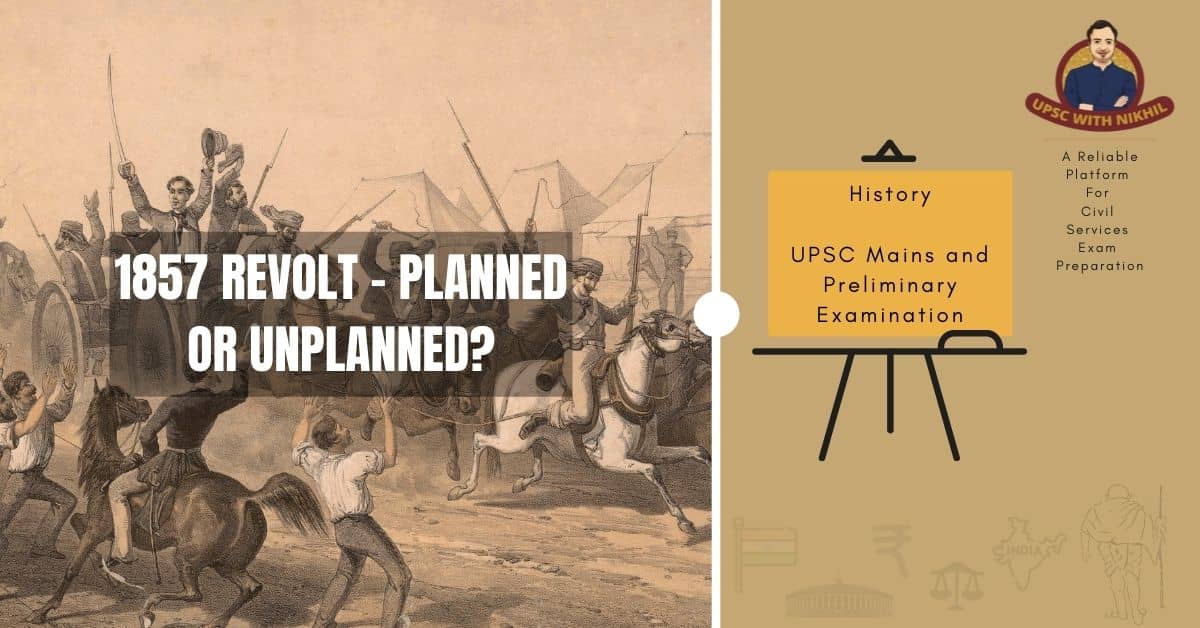
1857 Revolt - Planned Or Unplanned?
A. Atitude of leaders:
Bahadur Shah appears to have been taken aback when the sepoys arrived from Meerut, and he promptly informed the Lt.Governor in Agra. So did Rani Lakshmibai of Jhansi, who waited a long time before joining the rebels openly. Following the capture of Delhi, a letter was sent to the rulers of all the neighbouring states, as well as the rulers of Rajasthan, asking for their support and inviting them to participate.
• All rebel leaders acknowledged Bahadur Shah as the Emperor. In his name, coins were struck and orders were issued.
• Khan Bahadur Khan presided over the administration in Bareilly in the name of the Mughal Emperor. It is also significant that the rebels' first impulse, whether they were in Meerut, Kanpur, or Jhansi, was always to travel to Delhi. It was clear that an organisation and a political institution were needed to protect the gains. However, in the face of the British counter-offensive, there was no way to expand on thes The rebels were poorly served by their leaders, with the exception of some honourable exceptions such as the Rani of Jhansi, Kunwar Singh, and Maulvi Ahmadullah.

• The majority of them were unaware of the significance of the Revolt and simply did not do enough to help. Bahadur Shah and Zeenat Mahal had lost faith in the sepoys and sought protection from the British. The majority of taluqdars only tried to protect their own interests.
• Man Singh, for example, switched sides several times depending on which side held the upper hand.

B. AMMUNITION SHORTOUT:
• The insurgents fought against overwhelming odds for more than a year. They had no weapons or ammunition, and what they had taken from British arsenals wouldn't get them very far.
• They were frequently forced to fight with swords and pikes against an opponent who had access to the most advanced weapons.
C. MEDIUM OF COMMUNICATION:
• They didn't have a quick communication system at their disposal, so coordination was impossible.
• As a result, they were unaware of their fellow countrymen's strengths and weaknesses, and thus could not come to each other's aid in times of need. Everyone was left with a single hand to play.
D. SUPPORT FROM NATIVES:
• Although the people sympathised with the rebels, the country as a whole did not support them. Merchants, intellectuals, and Indian rulers not only remained silent, but actively backed the British.
• Despite the Doctrine of Lapse, Indian rulers who thought their future would be safer with the British lavished men and materials on them. Indeed, if the sepoys had received their support, they might have been able to put up a better fight.
• Almost half of the Indian soldiers did not only not revolt, but also fought against their own people. Five columns of 1700 British troops and 3200 Indians were responsible for the recapture of Delhi.
• Six British officers and NCOs, as well as twenty-four Indians, ten of whom were Punjabis and fourteen from Agra and Oudh, were responsible for blowing up Kashmere Gate.

OUTCOME:
• Despite the fact that this was not to be, the rebels displayed extraordinary courage, dedication, and commitment. Thousands of men risked their lives to fight for a cause they believed in. Their valour, however, was insufficient to fend off a far superior British army.
• Delhi was the first to fall, on September 20, 1857, after a long battle. Bahadur Shah was apprehended, tried, and deported to Burma after taking refuge in Humayun's tomb. Because Delhi was the only possible rallying point, the Revolt's back was broken. After that, the British military dealt with the insurgents in one city after another.
• On June 17, 1858, the Rani of Jhansi was killed in a battle. When General Hugh Rose defeated her, he paid tribute to her by saying, "Here lay the woman who was the only man among the rebels."
• Nana Saheb refused to give up and fled to Nepal in the early months of 1859, hoping to resume the fight.
• Despite his advanced age, Kunwar Singh was too quick for the British troops and kept them guessing until his death on May 9, 1858.
• Tantia Tope, who successfully fought the British in guerrilla warfare until April 1859, was betrayed by a zamindar, captured, and executed by the British.
1857: A SOURCE OF ETERNAL INSPIRATION
1. As a result, the British Empire's most formidable challenge in India came to an end. It's impossible to say what the course of history would have been if the rebels had prevailed. It is unnecessary to speculate on whether they would have ‘turned back the clock' and resurrected and reinforced a feudal order; however, this was not the only option.
2. Despite their flaws and limitations, the sepoys' effort to free the country from foreign rule was a patriotic and progressive act. The Revolt of 1857 was not a pure historical tragedy if the significance of a historical event is not limited to its immediate achievements. Even in its failure, it served an important purpose: it served as a source of inspiration for the national liberation movement, which went on to achieve what the Revolt had failed to.