

British Economic Policies In India (1757-1857)
COMMERCIAL POLICY:
From 1600 to 1757, the East India Company served as a trading company in India, bringing goods and precious metals into the country and exchanging them for Indian goods such as textiles and spices, which it then exported. Its profits were primarily derived from the export of Indian goods. Naturally, it attempted to open new markets for Indian goods in the United Kingdom and other countries on a regular basis. As a result, it increased Indian manufacturers' exports and thus encouraged their production. This is why Indian rulers tolerated and even encouraged the Company's factories to be built in the country.

• British manufacturers were envious of Indian textiles' popularity in the United Kingdom from the start. Dress fashions abruptly changed, and light cotton textiles began to replace the English's coarse woollens.
• Manufacturers in the United Kingdom exerted pressure on their government to restrict and prohibit the sale of Indian goods in the United Kingdom. By 1720, laws prohibiting the wearing or use of printed or dyed cotton cloth had been passed.
• Imports of plain cloth were also subjected to high tariffs. Except for Holland, other European countries either prohibited or imposed high import tariffs on Indian cloth.
• Despite these laws, Indian silk and cotton textiles continued to hold their own in international markets until the mid-eighteenth century, when the English textile industry began to develop on the basis of new and advanced technology.
• The pattern of the Company's commercial relations with India changed dramatically after the Battle of Plassey in 1757. The Company could now use its political clout in Bengal to gain monopolistic control over Indian trade and production, allowing it to push its Indian business forward.

• Furthermore, it used Bengal revenues to fund its export of Indian goods. The Company's activities should have encouraged Indian manufacturers, as Indian exports to the United Kingdom increased from £1.5 million in 1750-51 to £5.8 million in 1797-98, but this was not the case.
• The Company used its political clout to impose terms on Bengal weavers, who were forced to sell their wares at a lower, dictated price, even if it meant losing money. Furthermore, their work was no longer free. Many of them were forced to work for the Company for low pay and were prohibited from working for Indian merchants.
• The Company eliminated its rival traders, both Indian and foreign, and prevented them from offering the Bengal handicraftsmen higher wages or prices.
• The Company's servants monopolised the sale of raw cotton, forcing Bengal weavers to pay exorbitant prices. As a result, the weaver lost both as a buyer and as a seller. At the same time, when Indian textiles entered England, they were subjected to high tariffs.
• The British government was determined to protect its burgeoning machine industry, whose products were still unable to compete with the lower-cost, higher-quality Indian products. Despite this, Indian products maintained some of their market share.
• The real blow to Indian handicrafts came after 1813, when they lost not only their international markets but, more importantly, their domestic markets. Britain's economy and economic relations with India were completely transformed by the Industrial Revolution.
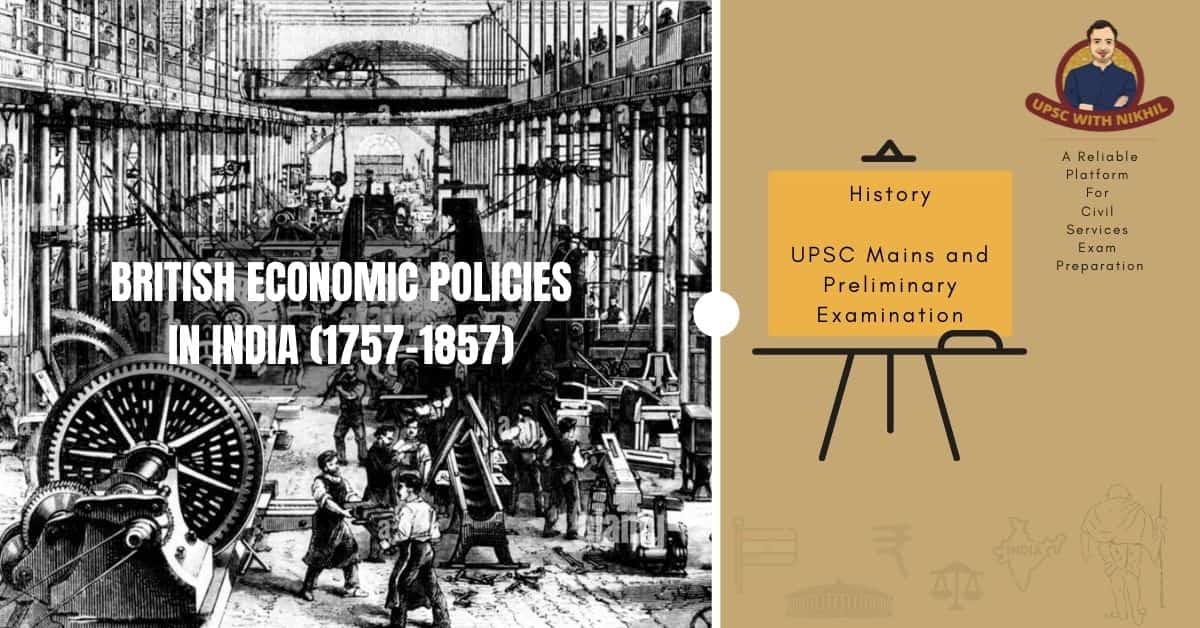
• Britain underwent profound social and economic transformation in the second half of the eighteenth century and the first few decades of the nineteenth century, and British industry developed and expanded rapidly on the basis of modern machines, the factory system, and capitalism.
• Several factors contributed to this development. In previous centuries, British overseas trade had been rapidly expanding. By means of war and colonialism, Britain had been able to capture and monopolise many foreign markets.
• These export markets allowed its export industries to rapidly expand production while utilising cutting-edge production and organisation techniques. Africa, the West Indies, Latin America, Canada, Australia, China, and, most importantly, India offered limitless export opportunities. This was especially true of the cotton textile industry, which was the main engine of the British Industrial Revolution.
Britain had already developed a colonial trade pattern that aided the Industrial Revolution, which in turn strengthened it:
A. Colonies and underdeveloped countries exported agricultural and mineral raw materials to Britain, while the latter sold them manufactured goods.
B. The country had accumulated sufficient capital to invest in new machinery and the factory system. Furthermore, this capital was concentrated in the hands of merchants and industrialists who were eager to invest it in trade and industry, rather than in the hands of the feudal class, who would waste it on luxurious living. The immense wealth derived from Africa, Asia, the West Indies, and Latin America, including that derived from India by the East India Company and its servants following the Battle of Plassey, played an important role in financing industrial expansion once again
C. Rapid population growth met the growing industries' demand for more and cheaper labour. After 1740, Britain's population grew rapidly, more than doubling in fifty years after 1780.
D. Britain had a government influenced by commercial and manufacturing interests, and as a result, it fought other countries ferociously for markets and colonies.
E. Technological advancements met the demand for increased production. The inventions of Hargreaves, Watt, Crompton, Cartwright, and others could serve as the foundation for Britain's burgeoning industry. Many of the modern inventions have been around for centuries. Production was increasingly concentrated in factories to take full advantage of these inventions and steam power. It's worth noting that the Industrial Revolution was not sparked by these inventions. Rather, manufacturers' desire to increase production quickly in response to expanding markets, as well as their ability to invest the necessary capital, drove them to use existing technology and invent new ones.
• In fact, the new industrial structure was designed to make technological change a permanent feature of human development. In this sense, the Industrial Revolution never ended, because modern industry and technology have been evolving from one stage to the next since the middle of the eighteenth century.
• The Industrial Revolution had a profound impact on British society. It resulted in rapid economic development, which is the foundation of today's high living standards. In fact, until the beginning of the nineteenth century, there was little difference between the living standards of what are now economically advanced and backward countries.
• The absence of the Industrial Revolution in the latter group of countries is responsible for the massive income disparity that exists today. As a result of the Industrial Revolution, Britain became increasingly urbanised. Factory towns began to attract an increasing number of residents. In 1750, Britain had only two cities with populations of more than 50,000 people; by 1851, there were 29.
• The industrial capitalists, who owned the factories, and the workers who hired out their labour on a daily wage were two entirely new classes of society. While the former class grew rapidly and experienced unprecedented prosperity, the workers—the working poor—reaped a harvest of misery at first.
• Their traditional way of life was disrupted and destroyed as they were uprooted from their rural surroundings. They were now forced to live in filthy, smoke-filled cities. Housing was woefully inadequate and filthy.
• The factory and mine working hours were intolerably long, often exceeding 14 or 16 hours per day. Wages were pitiful.
• Women and children both had to put in the same amount of effort. Children as young as four or five years old were occasionally employed in factories and mines.
• A worker's life was characterised by poverty, hard labour, disease, and malnutrition. It wasn't until the middle of the nineteenth century that they began to see an increase in their earnings.
• The rise of a powerful manufacturing class had a significant impact on Indian policymaking and administration. This class's interest in the Empire was very different from the East India Company's.
• It benefited nothing from monopolising the export of Indian handicrafts or appropriating Indian revenues directly. As this class grew in size, strength, and political clout, it began to challenge the Company's trade monopoly. Because this class's profits came from manufacturing rather than trading, it wanted to encourage not imports of manufactured goods from India, but exports of its own products to India as well as imports of raw materials from India, such as raw cotton.
• However, this increase was insufficient to meet the lofty expectations of Lancashire manufacturers, who began actively seeking ways to promote the export of their goods to India.
• The Parliamentary Select Committee of 1812 sought to “discover how they (Indian manufacturers) could be replaced by British manufacturers, and how British industries could be promoted at the expense of Indian industries,” as R.C. Dutt noted later in 1901 in his famous work, The Economic History of India.
• The East India Company, with its monopoly of eastern trade and methods of exploitation of India through control of India's revenues and export trade, was seen as the primary impediment to the realisation of British manufacturers' dreams.
• They waged a successful campaign against the Company and its commercial privileges between 1793 and 1813, eventually succeeding in abolishing the Company's monopoly of Indian trade in 1813.
• A new era in Britain's economic relations with India began with this event. Agricultural India was to become an industrial England's economic colony. The Indian government now pursued a policy of free trade, or the unrestricted entry of British goods into the country.
• Indian handicrafts faced extinction as a result of the fierce and unequal competition from Britain's machine-made products. India had no choice but to accept British goods at zero or nominal tariff rates. By pursuing a policy of new conquests and direct occupation of protected states like Awadh, the Indian government attempted to increase the number of purchasers of British goods.
• Many British officials, politicians, and business leaders advocated for a reduction in land revenue so that Indian peasants could afford to buy foreign goods. They also advocated for India's westernisation in order for more Indians to develop a taste for Western products.
• Indian handicrafts were unable to compete with the much cheaper products produced by British mills, which had been rapidly increasing their productive capacity through the use of inventions and the expanded use of steam power.
• Any government devoted solely to Indian interests would have erected high tariff barriers to protect Indian industry and used the time gained to import Western techniques.
• In the eighteenth century, Britain had done this in relation to its own industries; France, Germany, and the United States of America were also doing so at the time; Japan and the Soviet Union would do it many decades later; and free India is doing it today.
• Foreign rulers, on the other hand, did not only fail to protect Indian industries, but also allowed free entry of foreign goods. Imports from other countries increased rapidly. The value of British cotton imports rose in 1856.
• India, on the other hand, was subjected to one-sided free trade. While India's doors were thus opened wide to foreign goods, Indian products that could still compete with British products were subjected to high import duties upon entry into the United Kingdom.
• Even when their industries had achieved technological superiority over Indian handicrafts, the British would not accept Indian goods on fair and equal terms.
• Duties on a variety of Indian goods remained high in the United Kingdom until their export to the country was virtually halted. In 1824, for example, a duty of 67 12 percent was imposed on Indian calicos and a duty of 3712 percent was imposed on Indian muslins.
• On entry into the United Kingdom, Indian sugar had to pay a duty that was more than three times its cost price. In some cases, duties in England were increased by as much as 400%.

• Indian exports to foreign countries plummeted as a result of such high import tariffs and the development of machine industries. If this had not been the case, if such prohibit duties and decrees had not been in place, the mills of Paisley and Manchester would have been shut down from the start and could scarcely have been restarted, even with the power of steam. They were made possible by the Indian manufacturer's sacrifice.
• If India had been independent, she would have retaliated by imposing preventive tariffs on British goods, thereby saving her own productive industry from extinction. She was not allowed to defend herself; she was at the mercy of the stranger.
• The foreign manufacturer used the arm of political injustice to keep down and eventually strangle a competitor with whom he could not have competed on equal terms.
• Instead of exporting manufactured goods, India was now forced to export raw materials such as raw cotton and raw silk, which British industries desperately needed, or plantation products such as indigo and tea, as well as food grains that were in short supply in the United Kingdom.
• The British also encouraged the sale of Indian opium in China, despite the Chinese government's prohibition due to its poisonous and other negative effects. The trade, on the other hand, brought large profits to British merchants and large revenues to the Company's administration in India.
• Intriguingly, opium imports into the United Kingdom were strictly prohibited. India's main exports by the end of the nineteenth century were raw cotton, jute, and silk, oilseeds, wheat, hides and skins, indigo, and tea.
• After 1813, the East India Company's commercial policy was guided by the needs of British industry. Its main goal was to turn India into a consumer of British goods and a raw material supplier.