

First And Second Anglo-burmese War
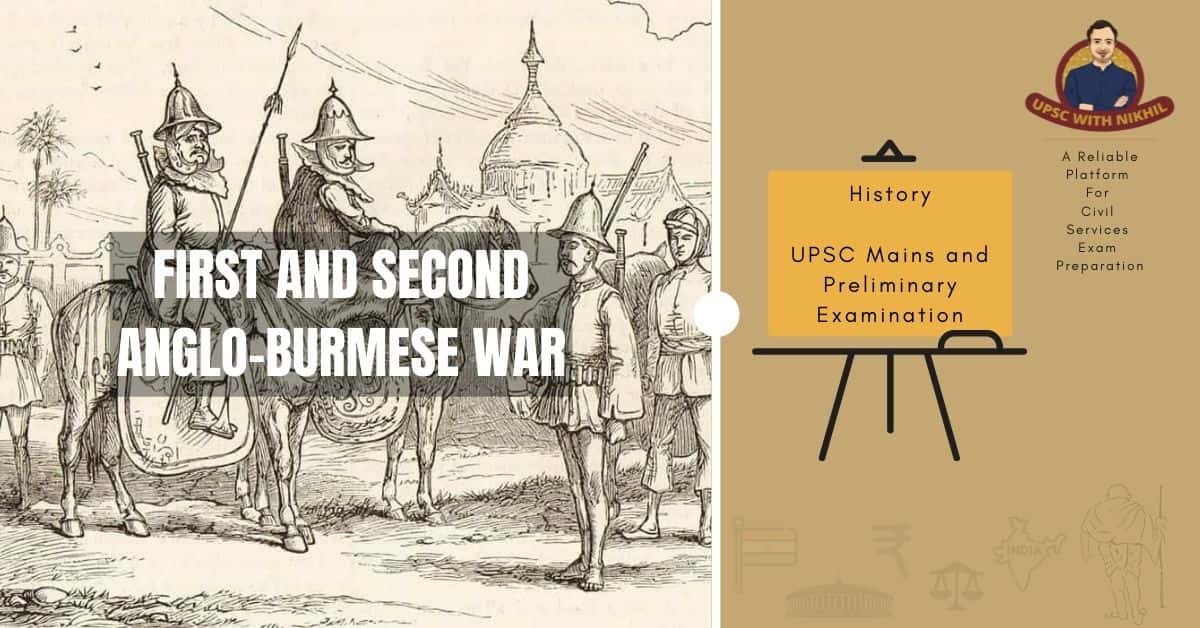
Border clashes between Burma and British India sparked the conflict. The expansionist impulses snubbed it. British merchants were envious of Burma's forest resources and eager to promote the export of their manufactured goods to its people. The British authorities were also concerned about the spread of French commercial and political influence in Burma and Southeast Asia. During the nineteenth century, the British conquered the independent kingdom of Burma in three successive wars.

FIRST BURMESE WAR, 1824-26
• At the end of the 18th century, when both countries were expanding, Burma and British India formed a common border. Between 1752 and 1760, King Alaungpaya brought Burma together after centuries of internal strife
• Bodawpaya, King Alaungpaya's successor, ruled from Ava on the Irrawaddi River, and invaded Siam several times, repelled many Chinese invasions, and conquered the Border States of Arakan (1785) and Manipur (1813), bringing Burma's border with British India. He threatened Assam and the Brahmaputra Valley as he continued his westward expansion.
• Assam was conquered by the Burmese in 1822. The occupation of Arakan and Assam by the Burmese resulted in ongoing tensions along the ill-defined border between Bengal and Burma.
• The Burmese government pressed the British government to act against the insurgents (Arakanese fugitives) and hand them over to Burmese authorities.

• Burmese forces pursuing insurgents frequently crossed into Indian Territory. Conflicts on the Chittagong Arakan frontier erupted in 1823 over possession of Shahpuri Island, which had been occupied by both the Burmese and the British.
• After the British rejected the Burmese proposal to neutralise the island, tensions between the two countries began to rise. The occupation of Manipur and Assam by the Burmese created yet another source of friction between the two countries.
• The British authorities viewed it as a serious threat to their position in India. They established British influence over the strategic border states of Cachar and Jaintia to counter this threat. The British action enraged the Burmese, who marched their troops into Cachar. Following a clash between Burmese and British troops, the Burmese were forced to retreat to Manipur.
• For decades, British Indian authorities tried to persuade the Burmese government to sign a commercial treaty with them, excluding French traders from the country.
• The British believed that Burmese power should be broken as soon as possible, especially since they believed that British power was far superior to Burmese power at the time. On their part, the Burmese did nothing to avoid war. Because the Burmese rulers had been cut off from the rest of the world for so long, they misjudged the enemy's strength. They were also led to believe that an Anglo-Burmese war would lead to the revolt of many Indian powers.
• On February 24, 1824, the war was declared officially. The British forces drove the Burmese out of Assam, Cachar, Manipur, and Arakan after an initial setback.
• In May 1824, British expeditionary forces by sea occupied Rangoon and came within 45 miles of Ava, the capital.
• In April 1825, the famous Burmese General Maha Bandula was assassinated. Burmese resistance, on the other hand, was tenacious and unyielding. Guerrilla warfare in the jungles was particularly effective.
• The war's cruelty was exacerbated by the rainy climate and virulent diseases. More people died from fever and dysentery than from the war
• 3,160 people died in hospitals and 166 on the battlefield in Rangoon. Out of the 40,000 British troops who landed in Burma, 15,000 were killed.
• The war was proving to be extremely costly (both financially and in terms of human lives), so both the British, who were winning the war, and the Burmese, who were losing it, were relieved when the Treaty of Yandabo was signed in February 1826.
The Burmese government agreed –
1. to pay a compensation of one crore rupees for the war
2. to relinquish control of the Arakan and Tenasserim coastal provinces
3. to give up any claims to Assam, Cachar, or Jaintia; recognising Manipur as a sovereign state
4. to negotiate a trade agreement with the United Kingdom
5. to accept a British Resident in Ava while stationing a Burmese envoy in Calcutta
The British gained a firm base in Burma for future expansion as a result of this treaty, which stripped Burma of most of its coastline.

SECOND BURMESE WAR (1852)
• If the First Burmese War was partly caused by border conflicts, the second Burmese War, which began in 1852, was almost entirely caused by British commercial greed. The timber resources of Upper Burma had piqued the interest of British timber companies. Furthermore, the British perceived Burma's large population as a large market for the sale of British cotton goods and other manufactured goods.
• The British, who had already taken control of Burma's two coastal provinces, wanted to establish trade relations with the rest of the country, but the Burmese government refused.
• British merchants began to complain about the Burmese authorities in Rangoon's "lack of trade facilities" and "oppressive treatment."
• The truth was that British imperialism was at its pinnacle, and the British considered themselves to be superior to the rest of the world. Merchants in the United Kingdom had begun to believe that they had a divine right to impose their trade on others.
• By the time, the brash Lord Dalhousie had risen to the position of Governor-General of India. He was chosen to increase British imperial prestige and advance British interests in Burma.
• Dalhousie used the frivolous and petty complaint of two British sea captains that the Governor of Rangoon had extorted neatly 1,000 rupees from them as an excuse for armed intervention in Burma.
• In November 1851, Dalhousie dispatched an envoy to Rangoon, escorted by several warships, to demand compensation for the two British merchants.
• The British envoy, Commodore Lambert, acted aggressively and unnecessarily. He demanded the removal of the Governor of Rangoon before agreeing to negotiate when he arrived in Rangoon.
• The Court at Ava was so shaken by the British display of power that it agreed to recall the Governor of Rangoon and investigate British complaints. The arrogant British envoy, on the other hand, was dead set on inciting a conflict. He began a blockade of Rangoon, attacking and destroying more than 150 small ships in the port.
• The Burmese government agreed to accept a British Resident in Rangoon and pay the British the full compensation demanded.
• The Indian government has now tightened the screws and raised their demands to absurd levels. They demanded that the new Governor of Rangoon be recalled, as well as an apology for alleged insults directed at their envoy.
• An independent government would be hard pressed to accept such demands. Clearly, the British wanted to strengthen their grip on Burma, either through peace or war, before their trade rivals, the French and Americans, could establish themselves there.
• In April 1852, a full British expedition was dispatched to Burma. The war was much shorter this time than it was in 1825-1826, and the British victory was more decisive.
• Rangoon was quickly taken, followed by other important towns such as Basein, Pegu, and Prome. Burma was in the midst of a power struggle at the time. Mindon, the Burmese King, who had deposed his half-brother, King Pagan Min, in a power struggle in February 1853, was in no position to fight the British; at the same time, he couldn't openly agree to surrender Burmese territory. As a result, there were no formal peace negotiations, and the war ended without a treaty.
• The British now had complete control of Burma's coastline and sea trade. Indian soldiers bore the brunt of the fighting, and the war's costs were entirely covered by Indian revenues