

Gandhiji: Partition And Freedom
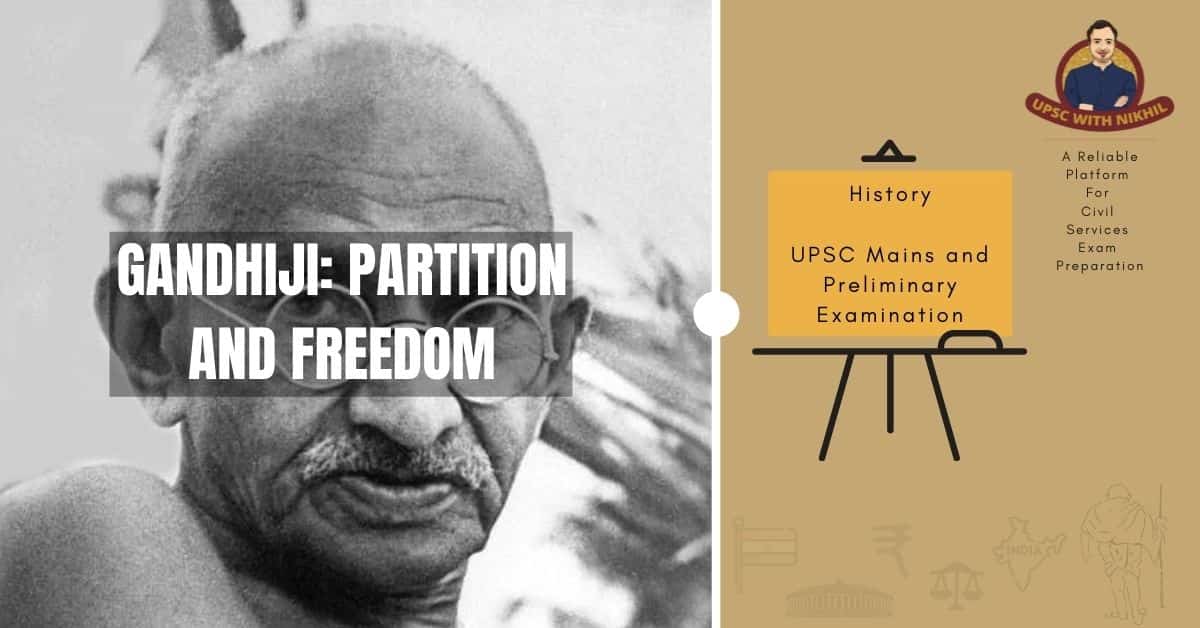
What about Mahatma Gandhi? The unhappiness and helplessness of Gandhiji have been well-documented. His inaction has been attributed to his forced exclusion from Congress decision-making bodies, as well as his inability to condemn his disciples, Nehru and Patel, for succumbing to the lust for power, despite the fact that they had faithfully followed him for many years. At a great personal cost.
• The root of Gandhiji's helplessness, in our opinion, was not Jinnah's intransigence or his disciples' alleged lust for power, but rather his people's communalization.
• He explained that Congress accepted Partition because the people wanted it at a prayer meeting on June 4, 1947: ‘the demand has been granted because you asked for it.' It was never requested by Congress.
• The Congress, on the other hand, can sense the people's pulse. It realised that both the Khalsa and Hindus wanted it.'

• The desire for Partition by Hindus and Sikhs rendered him ineffective, blind, and powerless. He was already regarded as a Muslim foe.
• What good was a mass leader if no one would listen to him? How could he build a movement to combat communalism on the backs of communists? When he saw clearly that the time was right for a struggle, he could defy the leaders' advice, as he had done in 1942. But, as he told N.K. Bose when he asked him to, he couldn't "create a situation."
• In his own words, his special ability was limited to being able to "intuitively feel what is stirring in the hearts of the masses" and "giving shape to what was already there." There were no ‘forces of good' for Gandhiji to ‘seize' in 1947 in order to ‘build up a programmer' -— ‘Toy, I see no sign of such a healthy feeling.' Riots in Noakhali
• As a result, I'll have to wait until the right time comes.' Political developments, on the other hand, did not wait for a "blind man groping in the dark all by himself" to find a way to the light.
• Gandhiji saw the inevitability of Partition in the ugly gashes left on the country's face by riots, as well as the rigour mortis into which the Interim Government had fallen.
• On the 14th of June, 1947, he bravely entered the AICC meeting and asked Congressmen to accept Partition as an unavoidable necessity under the circumstances, but to tighten it in the long run by refusing to accept it in their hearts.

• In his heart, he refused to accept it and, like Nehru, maintained his faith in his people. He chose to plough a lonely furrow, walking barefoot through the villages of Noakhali, instilling faith in the Muslims of Bihar and preventing riots in Calcutta through persuasion and threats of a fast.
• His favourite song had long been Ekla Cholo's "If No One Heeds Your Call, Walk Alone, Walk Alone": "If No One Hears Your Call, Walk Alone, Walk Alone." That is exactly what he did.
• The dawn of the 15th of August 1947 revealed the dual reality of independence and partition. Gandhiji and Nehru, as always, mirrored the feelings of the Indian people between them.
• In Calcutta, Gandhiji prayed for an end to the slaughter. Mridula Sarabhai, a close friend of his, sat in a room somewhere in Bombay, consoling a homeless, kidnapped 15-year-old girl. Gandhiji's prayers reflected the events of the night, the murders, kidnappings, and rapes. Nehru's gaze was drawn to the new dawn on the horizon, the birth of a free India. ‘India shall awaken to light and freedom at the stroke of midnight, when the world sleeps.'
• ‘Long years ago, we had a tryst with destiny,' he said poetically, reminding the crowd that their angry bewilderment today was not the only truth. There was a greater truth — that of a glorious struggle, hard-fought and hard-won, in which many people died as martyrs and countless others gave their lives in the hope of seeing India free one day. That day had finally arrived.
• The people of India recognized this as well, and on August 15, despite their sadness over the division of their country, they danced in the streets with abandon and joy.
THE MID-NIGHT FREEDOM SPEECH: TRYST WITH DESTINY
“Long years ago, we made a tryst with destiny; and now the time comes when we shall re¬deem our pledge, not wholly or in full measure, but very substantially. At the stroke of the midnight hour, when the world sleeps, India will awake to life and freedom.
A moment comes, which comes but rarely in history, when we step out from the old to the new -- when an age ends, and when the soul of a nation, long suppressed, finds utterance. It is fitting that at this solemn moment we take the pledge of dedication to the service of India, and her people, and to the still larger cause of humanity.

• At the dawn of history India started on her unending quest and trackless centuries which are filled with her striving and the grandeur of her successes and her failures. Through good and ill fortunes alike, she has never lost sight of that quest or forgotten the ideals which gave her strength. We end today a period of ill fortune and India discovers herself again.
• The achievement we celebrate today is but a step, an opening of opportunity, to the greater triumphs and achievements that await us. Are we brave enough and wise enough to grasp this opportunity and accept the challenge of the future?
• Freedom and power bring responsibility. That responsibility rests upon this assembly, a sov¬ereign body representing the sovereign people of India. Before the birth of freedom we have endured all the pains of labor, and our hearts are heavy with the memory of this sorrow. Some of those pains continue even now. Nevertheless, the past is over, and it is the future that beckons to us now.
• That future is not one of ease or resting but of incessant striving so that we might fulfill the pledges we have so often taken and the one we shall take today. The service of India means the service of the millions who suffer. It means the ending of poverty and ignorance and dis¬ease and inequality of opportunity.
• The ambition of the greatest man1 of our generation has been to wipe “every tear from every eye.” That may be beyond us, but so long as there are tears and suffering, so long our work will not be over. And so we have to labour and to work and work hard, to -- to give reality to our dreams. Those dreams are for India, but they are also for the world, for all the nations and peoples are too closely knit together today for any one of them to imagine that it can live apart.
• Peace has been said to be indivisible; so is freedom; so is prosperity now; and so also is disas¬ter in this one world that can no longer be split into isolated fragments.
• To the people of India, whose representatives we are, we make appeal to join us with faith and confidence in this great adventure. This is no time for petty and destructive criticism, no time for ill will or blaming others. We have to build the noble mansion of free India where all her children may dwell.”