

How British Deteriorated The Agriculture?
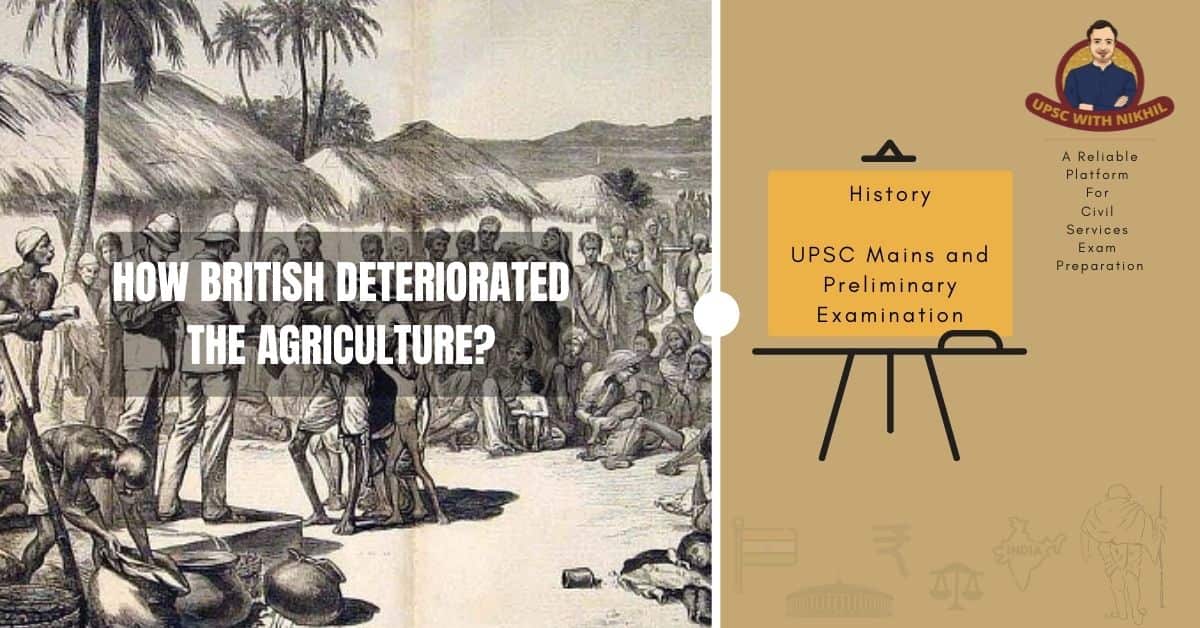
Indian agriculture began to stagnate and even deteriorate as a result of overcrowding in agriculture, excessive land revenue demand, and growth of landlordism, increasing indebtedness, and growing impoverishment of cultivators, resulting in extremely low yields per acre. Between 1901 and 1939, total agricultural production fell by 14%. Overcrowding in agriculture and an increase in subinfeudation resulted in land being divided and fragmented into small holdings, the majority of which were unable to maintain their cultivators. The overwhelming majority of peasants were unable to improve agriculture by using better cattle and seeds, more manure and fertilisers, and improved production techniques due to their extreme poverty.

• The cultivator, who was rack-rented by both the government and the landlord, had no such incentive. After all, the land he cultivated was almost never his, and the vast majority of the benefits that agricultural improvements would bring would almost certainly be reaped by the horde of absentee landlords and moneylenders.
• It was also difficult to make improvements due to land subdivision and fragmentation. The rich landlords of England and other European countries frequently invested capital in their land to increase its productivity in order to share in the increased income.
• However, absentee landlords, both old and new, served no useful purpose in India. They were merely rent collectors who had little or no ties to the land and had no personal interest in it other than to collect rent. They discovered that increasing their income by further squeezing their tenants was possible and preferred it to making productive investments in their lands.

• The revolution may have aided in the improvement and modernization of agriculture. The government, on the other hand, refused to revolutionise any such responsibility.
• The British Indian financial system was notable for the fact that, while the peasant bore the brunt of taxation, the government spent only a small portion of it on him. The step motherly treatment meted out to public works and agricultural improvement is an example of this neglect of the peasant and agriculture.

• While the Indian government had spent more than 360 crores of rupees on railways by 1905, as demanded by British business interests, it had spent less than 50 crores on irrigation, which would have benefited millions of Indian farmers. Despite this, irrigation was the only area where the government made progress.
• At a time when agriculture around the world was being modernised and revolutionised, Indian agriculture was stuck in the past, with little modern machinery being used. Worse, even everyday implements were hundreds of years old. In 1951, for example, there were only 930,000 iron ploughs in use, compared to 31.8 million wooden ploughs.
• Inorganic fertilisers were almost unknown, and a large portion of animal manure, such as cow dung, night soil, and cattle bones, was thrown away. Only 1.9 percent of all cropped land was under improved seeds in 1922—23. This percentage had only increased to 11% by 1938-39.
• Agricultural education was also completely overlooked. There were only six agricultural colleges in 1939, with a total of 1306 students.
• In Bengal, Bihar, Orissa, and Sind, there was not a single agricultural college. Peasants were also unable to improve themselves through self-study. Primary education, let alone literacy, was scarcely available in rural areas.