

Impoverishment Of Peasantry Under British
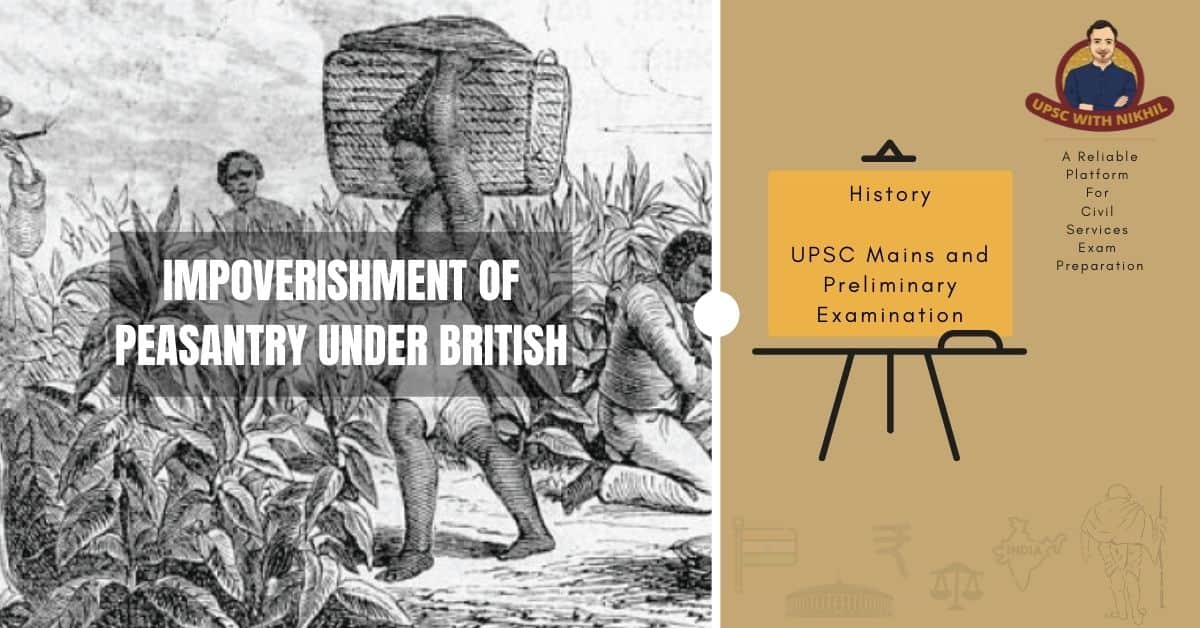
Under British rule, the peasantry became increasingly impoverished. Despite the fact that he was no longer embroiled in internal conflicts, his material situation deteriorated, and he gradually fell into poverty. Clive and Warren Hastings' policy of extracting the maximum possible land revenue had caused such devastation in Bengal at the start of British rule that even Cornwallis complained that one-third of Bengal had been transformed into "a jungle inhabited only by wild beasts."
• Improvement didn't happen later, either. The peasants' lot remained unenviable in both the Permanently Settled and Temporarily Settled Zamindari areas.

• They were left to the mercy of the zamindars, who raised rents to unaffordable levels, forced them to pay illegal dues, forced them to work as beggars, and oppressed them in a variety of other ways.
• Cultivators in the Ryotwari and Mahalwari areas were in no better shape. The government stepped in to replace the zamindars and imposed an excessive land revenue tax, which was initially set at one-third to one-half of the produce. Heavy land valuation was a major contributor to the rise of poverty and deterioration of agriculture in the nineteenth century. This fact was noted by many contemporary writers and officials.
Bishop Heber, for example, wrote in 1826: Neither Native nor European agriculturist, I think, can thrive at the present rate of taxation. Half of the gross produce of the soil is demanded by government. … In Hindustan [Northern India] I found a general feeling among the King’s officers… that the peasantry in the Company’s Provinces are on the whole worse off, poorer and more dispirited than the subjects of the Native Provinces; and here in Madras, where the soil is, generally speaking, poor, the difference is said to be still more marked. The fact is, no Native Prince demands the rent which we do.

• Despite the fact that the demand for land revenue grew year after year—the proportion of total produce taken as land revenue tended to decline, particularly in the twentieth century as prices rose and production increased. As the disastrous consequences of demanding extortionate revenue became clear, no proportional increase in land revenue was made. However, by this time, the population pressure on agriculture had grown to the point where the lower revenue demands of later years weighed just as heavily on the peasants as the higher revenue demands of the Company's early years.
• Furthermore, by the twentieth century, the agrarian economy had collapsed, and landlords, moneylenders, and merchants had established strongholds in the village.
• The evil of high revenue demand was exacerbated by the fact that the peasant received little monetary compensation for his labour. Agriculture was given very little attention by the government.
• It spent almost all of its earnings on meeting the needs of the British-Indian administration, paying direct and indirect tribute to England, and promoting British trade and industry. Even the enforcement of the law tended to benefit merchants and moneylenders rather than peasants.
• The negative consequences of an excessive land revenue demand were exacerbated by the strict manner in which it was collected. Even if the harvest was below average or failed entirely, land revenue had to be paid on time and on schedule. However, even if he had been able to meet the revenue demand in good years, the peasant found it difficult to do so in bad years.
• When a peasant failed to pay his land tax, the government sold his land to recover the money owed to him. However, in the majority of cases, the peasant took the initiative and sold a portion of his land to meet the government's demand.
• In either case, peasant was evicted from his property. The inability to pay revenue drove the peasant to borrow money from a moneylender at high interest rates. He would rather go into debt by mortgaging his land to a moneylender or a wealthy peasant neighbour than lose it outright. He was also compelled to go to a moneylender whenever he couldn't make both ends meet. He, on the other hand, found it difficult to get out of debt once he was in it.
• The moneylender charged high interest rates and used cunning and deceptive tactics to get the peasant deeper and deeper into debt, including false accounting, forged signatures, and forcing the debtor to sign for larger amounts than he had borrowed, until he had to give up his land.
• The new legal system, as well as the new revenue policy, greatly aided the moneylender. The moneylender was subordinate to the village community in pre-British times. He couldn't behave in a way that the rest of the village despised. He couldn't, for example, charge usurious interest rates. In reality, interest rates were set by usage and public opinion.
• Furthermore, he could not seize the debtor's land; he could only take possession of the debtor's personal belongings, such as jewellery, or a portion of his standing crop. The British revenue system made it possible for a moneylender or a wealthy peasant to take possession of land by introducing land transferability.
• Even the benefits of peace and security established by the British legal system and police were primarily reaped by the moneylender, in whose hands the law placed enormous power; he also used the power of the purse to turn the expensive litigation process in his favour and to make the police serve his purposes.
• Furthermore, the literate and astute moneylender could take advantage of the peasant's ignorance and illiteracy to manipulate the complicated legal processes in order to obtain favourable judicial decisions.
Moneylenders, merchants, rich peasants, and other moneyed classes gradually sank deeper and deeper into debt, and more and more land passed into the hands of moneylenders, merchants, rich peasants, and other moneyed classes in the Ryotwari and Mahalwari areas.
• The process was repeated in the zamindari areas, where tenants lost their tenancy rights and were either ejected from the land or became moneylender's subtenants.
• During times of scarcity and famine, the process of transferring land from cultivators was accelerated. The Indian peasant had few savings for emergencies, and when crops failed, he turned to the moneylender not only to pay his land taxes, but also to feed himself and his family.
• The moneylender had become a major curse of the countryside by the end of the nineteenth century, and an important cause of rural people's growing poverty. The total rural debt was estimated to be Rs 300 crore in 1911. It had grown to Rs 1800 crore by 1937.
• The whole thing spiralled out of control. Taxation and rising poverty pushed cultivators into debt, which exacerbated their poverty. In fact, the cultivators frequently failed to recognise that the moneylender was an unavoidable cog in the imperialist exploitation machine, and they turned their rage on him because he appeared to be the visible cause of their poverty.

• During the Peasant Revolt of 1857, for example, the moneylender and his account books were frequently the first targets of attack for the peasantry. Such peasant behaviour quickly became the norm. The moneylender-turned-merchant was aided in exploiting the cultivator by the growing commercialization of agriculture. Because he had to meet the demands of the government, the landlord, and the moneylender in a timely manner, the poor peasant was forced to sell his produce shortly after harvest and at whatever price he could get.
• This left him at the mercy of the grain merchant, who was able to dictate terms and buy his produce for a fraction of the market price. As a result, the merchant, who was frequently also the village moneylender, reaped a large share of the benefits of the growing agricultural trade.
• Landless peasants and ruined artisans and handicraftsmen were forced to become either tenants of moneylenders and zamindars by paying rack-rent or agricultural labourers at starvation wages as a result of de-industrialisation and lack of modern industry.
• As a result, the peasantry was crushed by the government, the zamindar (landlord), and the moneylender. After these three had taken their share, the cultivator and his family were left with very little.
• According to estimates, land rent and moneylenders' interest totaled Rs 1400 crore in 1950-51, or roughly one-third of total agricultural output for the year. As a result, the peasantry's impoverishment continued, along with an increase in the number of famines. Whenever droughts or floods caused crop failure and scarcity, millions of people died.