

Lord Dalhousie
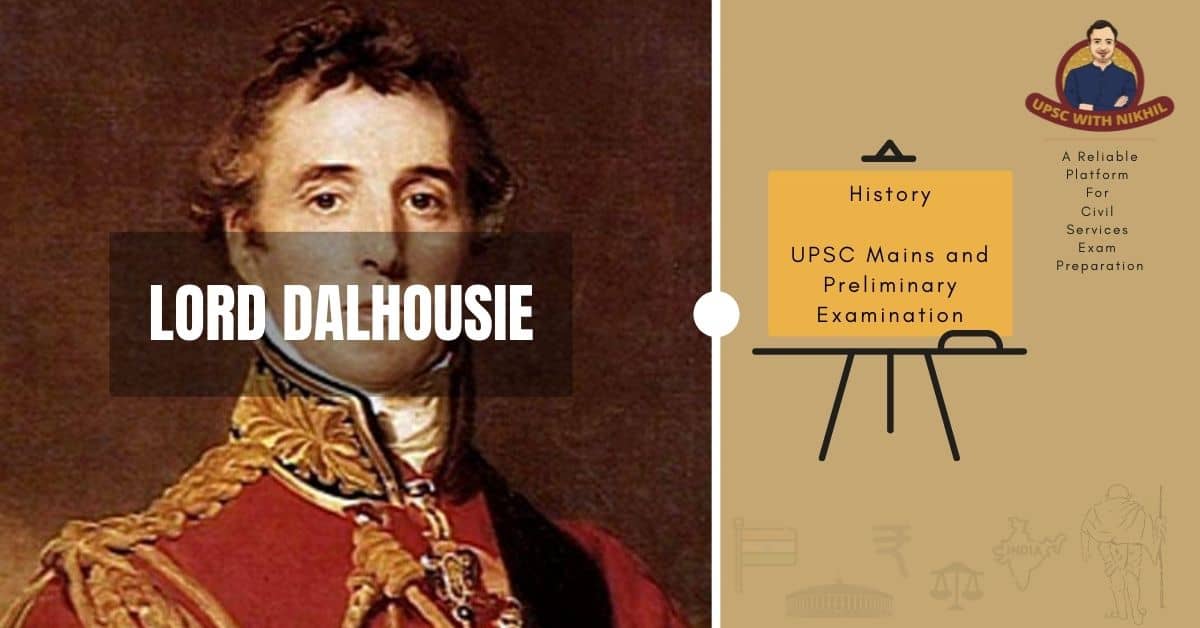
In 1848, Lord Dalhousie was appointed Governor-General of India. He was determined from the start to extend direct British rule over as much territory as possible. “The extinction of all native states of India is just a matter of time,” he said. The overarching goal of this policy was to increase British exports to India. Dalhousie, like other aggressive imperialists, believed that British exports to India's native states were suffering as a result of their Indian rulers' mismanagement. Furthermore, they believed that their "Indian allies" had already served their purpose of facilitating the British conquest of India and could now be profitably removed.

DOCTRINE OF LAPSE:
• The ‘Doctrine of Lapse' was the main tool used by Lord Dalhousie to carry out his annexation policy. When a ruler of a protected state died without a natural heir, his state was not to pass to an adopted heir as permitted by the country's long-standing tradition.
• Unless the adoption had been clearly approved earlier by British authorities, it was to be annexed to British India. This doctrine was used to annexe many states, including Satara in 1848 and Nagpur and Jhansi in 1854.
• Many ex-rulers' titles were also not recognised by Dalhousie, and their pensions were not paid. As a result, the Nawabs of Carnatic and Surat, as well as the Raja of Tanjore, lost their titles.
• Similarly, Dalhousie refused to extend his pay or pension to his adopted son, Nana Saheb, after the death of ex-Peshwa Baji Rao II, who had been made the Raja of Bithur.

• The annexation of the kingdom of Awadh was a priority for Dalhousie. However, the task was not without its difficulties. For one thing, since the Battle of Buxar, the Nawabs of Awadh had been British allies. Furthermore, they had been extremely loyal to the British over the years. Because the Nawab of Awadh had so many heirs, he was not covered by the Doctrine of Lapse.
• Another reason had to be found to deprive him of his throne. Finally, Lord Dalhousie came up with a solution to the people of Awadh's plight. Nawab Wajid Ali Shah was accused of mismanaging his kingdom and refusing to implement reforms. As a result, his state was annexed in 1856.

• The degeneration of Awadh's administration was undoubtedly a painful reality for its people. The Nawabs of Awadh, like other princes of the time, were self-centered rulers who were unconcerned about good administration or the welfare of the people.
• However, the British, who had controlled and indirectly governed Awadh since at least 1801, bore some responsibility for the current state of affairs.
• In reality, Dalhousie's greed and philanthropic feelings were aroused by the immense potential of Awadh as a market for Manchester goods.
• In 1853, Dalhousie took the cotton-producing province of Berar from the Nizam for similar reasons, in order to meet Britain's growing demand for raw cotton. It must be understood that the question of whether native states should be maintained or annexed was irrelevant at the time.
• At the time, there were no Indian states in existence. The British Empire included the protected native states just as much as the territories ruled directly by the Company. It was for British convenience that the form of British control over some of these states was changed. The change had little to do with their people's interests.