

Reasons For Dual Government In Bengal
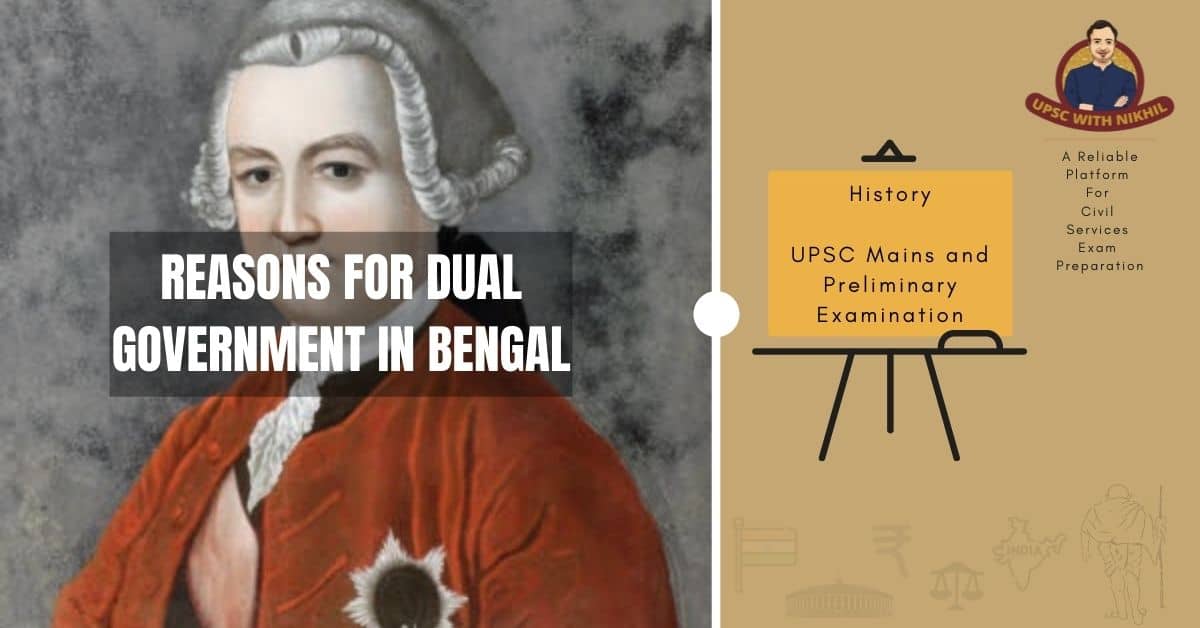
Nawab-ud-Daulla and Saif-ud-Daulla were the Nawabs of Bengal during the Dual System. Robert Clive established the infamous dual system of administration in Bengal after the Treaty of Allahabad (1765). The administration of Bengal was divided into Nizamat and Diwani under this system. East India Company was given Diwani (the right to collect revenue) and Bengal Nawab was given Nizamat (administrative responsibility).

• The Mughal emperor gave the British administration the Diwani or revenue Diwani (Fiscal) functions. Despite the fact that the administration was theoretically split between the Company and the Nawab, the Company held complete power. The Mughal emperor's fiction of sovereignty and the formal authority of the Nawab were maintained under this system.
• The Company was authorised to collect provincial revenues as the diwan, and it had the power to nominate the deputy Nizam (deputy subahdar), giving it control over the Nizamat, or police and judicial powers.
• Without the consent of the Company, the deputy subahdar (appointed to assist the Nawab) could not be removed. However, the Company was neither willing nor able to collect the revenue directly at this time. As a result, two deputy diwans – Mohammad Reza Khan for Bengal and Raja Sitah Roy for Bihar – were appointed to carry out diwani functions.
• Mohammad Reza Khan also served as Nizam's deputy. In this way, the entire administration of Bengal was carried out through an Indian agency, despite the fact that the Company retained ultimate authority.

MERITS AND REASONS OF THE DUAL GOVERNMENT
1. Clive demonstrated his foresight by implementing a decentralisation policy in the Company's administration in Bengal. By adopting this policy, he was able to protect the British in India from the wrath of Indian rulers, who might have taken drastic measures to expel the British from India if things had gone differently.
2. Clive was able to save the company from the wrath of other European powers such as the French, Dutch, and Portuguese thanks to the dual system of government in Bengal. In the event of Clive's complete occupation of Bengal, these European powers would have stopped paying tariffs to the Company's servants.
3. Clive was astute enough not to take on Bengal's administration directly. He was well aware that the company's servants were unfamiliar with the languages, customs, traditions, and laws that applied to Bengalis. If they had been entrusted with the administration of Bengal in the event of Clive's occupation, they would have made a very bad impression.
4. In addition to their lack of understanding of the administrative task, their number was too small to handle it. Direct administration in Bengal was opposed by both the Board of Directors and the British Parliament.
5. Clive didn't want to irritate the home authorities by taking over Bengal's administration directly. Clive demonstrated his honour to the Board of Directors on the one hand, and saved the Company from the wrath of the British parliament on the other, by establishing Dual Government in Bengal.
6. The East India Company was able to avoid real responsibility for Bengal administration thanks to the dual government in Bengal. By successfully avoiding the hazards of administration, the English Company gained power and pelf through this system of government. The Nawab of Bengal was to be held accountable for all government omissions and commissions. Because of the exigencies of the time, Clive established Dual Government in Bengal. Under the circumstances, it created a favourable environment for the expansion of British power in India. Any other option would have resulted in the company's demise.
DEMERIT OF THE DUAL GOVERNMENT
1. Clive's Dual Government has been chastised in a number of ways. It had disastrous consequences. Bengal's administration was on the verge of collapsing. The responsibility was separated from the power.
2. The British had both power and money, whereas the Nawab had neither. He was only responsible for running the administration and accepting responsibility for any failures. With only a small annual grant of rupees 50 lakhs, the Nawab was unable to run the administration smoothly.

3. The company used the revenue it received from Bengal, Bihar, and Orissa to try to improve its own situation. Due to a lack of funds, the Nawab was unable to complete any public works. The Nawab also lacked the authority to enforce the law. As a result, lawlessness reigned supreme in most of Bengal.
4. Theft and rubbery cases have increased by leaps and bounds. Due to a lack of justice, the common people had to endure a great deal. During Clive's Dual Government, the state of Bengal's agriculture gradually deteriorated. Revenue collection power was solely in the hands of the corporation. As a result, the Nawab was unable to make any provisions for the development of Bengal's agriculture, such as irrigation. Due to a lack of funds, he was unable to advance loans to needy farmers.
5. The great famine of 1770 was an unintended consequence of the aforementioned difficulties. Bengal's poor administration resulted in a rapid increase in private trade. The East India Company's servants engaged in private trade and commerce without paying any taxes.
6. They made a lot of money from this illegal business. On the other hand, the merchants of Bengal suffered greatly as a result of excessive taxation. As a result, the Dual Government dealt a devastating blow to local commerce and trade.
7. Clive's Dual Government was also to blame for the decline of local industries. Local weavers were forced to work exclusively for the company by the company's employees. The company also took control of a number of other small local businesses.
8. Under the Dual Government system, people were unable to obtain proper justice. Because the British played such an important role in their appointment, the Nawab's judges were influenced by British authority. As a result, the judges failed to render an impartial decision, which was detrimental to the public interest.
9. Due to a decrease in revenue collection, the decline of agriculture under the Dual Government eventually led to the decline of the Company's income. As a result, Bengal saw Clive's Dual Government as a failure.
10. It caused a slew of complications in Bengal's administration. Abuses of power and corruption resulted from the company's lack of accountability.
This dual system was found to be ineffective, and it was abolished in 1772 by Lord Warren Hastings on the orders of the company's directors. Mubaraq-ud-Daulla was the Nawab of Bengal when this system came to an end.