

Structure Of British Government In India
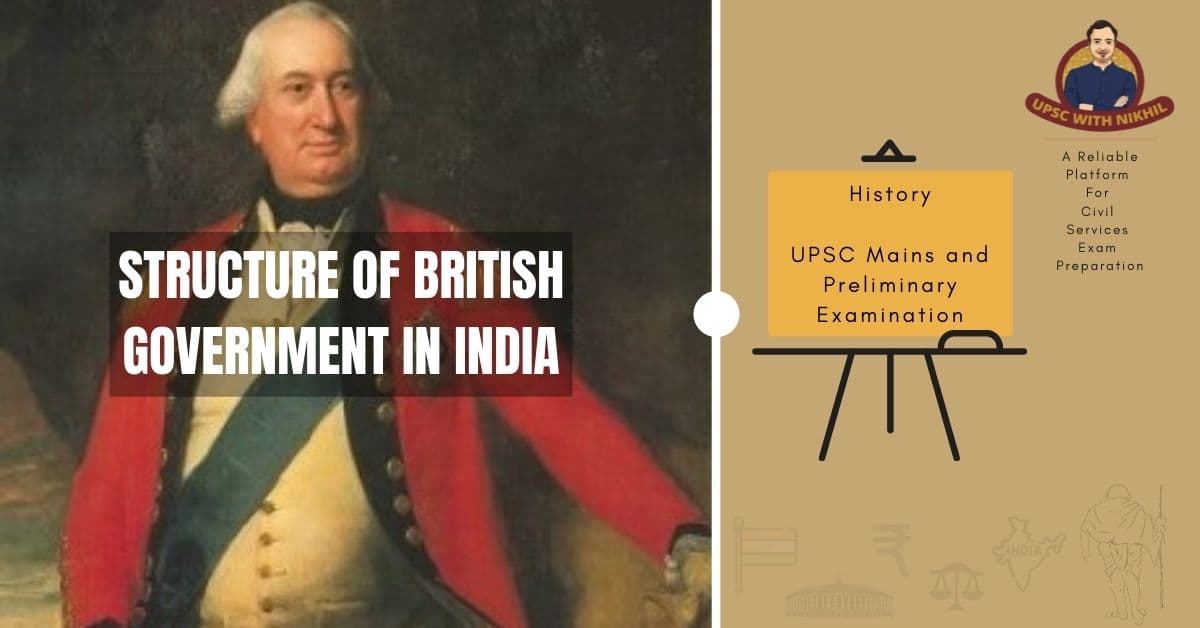
The East India Company had to devise suitable methods of government to control and administer India's vast empire after acquiring it. During the long period between 1757 and 1857, the Company's administrative policy changed frequently. However, it never lost sight of its primary goals, which were to increase the Company's profits, increase the profitability of its Indian holdings to Britain, and maintain and strengthen the British hold on India; all other goals were secondary. The administrative machinery of the Indian government was created with these goals in mind. The main focus in this regard was on maintaining law and order so that trade with India and the exploitation of its resources could take place without disruption.

THE STRUCTURE OF GOVERNMENT
• When the East India Company took control of Bengal in 1765, the officials had no intention of making any changes to the administration. They only wanted to continue their lucrative business and collect taxes for remittance to England.
• During the period of the Dual Government, which lasted from 1765 to 1772, Indian officials were allowed to operate as before, but under the overall control of the British Governor and British officials.
• The Indian officials were in charge but had no power, whereas the Company officials were in charge but had no responsibility. Both sets of officials were shady and dishonest.
• The Company abolished the Dual Government in 1772 and began administering Bengal directly through its servants. However, the dangers of a purely commercial company administering a country quickly became apparent.

• At the time, the East India Company was a commercial entity whose purpose was to trade with the East. Furthermore, the organization's higher authority was based in England, thousands of miles away from India. Nonetheless, it had amassed political clout over millions of people.
• The British government faced numerous challenges as a result of this unusual situation. The first of these issues was both the most pressing and the most critical. It was also intricately linked to British party and parliamentary rivalries, as well as English statesmen's political ambitions and merchants' commercial greed.
• The rich resources of Bengal had fallen into the hands of the Company, whose Directors immediately increased dividends to 10% in 1767 and proposed a further increase to 1212% in 1771.
• The English servants of the Company took advantage of their position to make quick money through illegal and unequal trade, as well as the forcible collection of bribes and gifts from Indian chiefs and zamindars. At the age of 34, Clive returned to England with a fortune and property worth £40,000 per year.
• Other sections of British society were alarmed by the Company's high dividends and the fabulous wealth brought home by its officials. Merchants barred from the East by the Company's monopoly, the growing class of manufacturers, and the rising forces of free enterprise in Britain in general all wanted a piece of the lucrative Indian trade and the riches of India that the Company and its servants were enjoying alone.
• They worked hard to dismantle the Company's trade monopoly, and in order to do so, they attacked the Company's Bengal administration. They also made the Company's officials who had returned from India a special target.
• These officials were mocked in the press and on stage, earning the moniker "nabobs." The aristocracy boycotted them, branding them as exploiters and oppressors of the Indian people. Clive and Warren Hastings were their two main targets.
• The opponents of the Company hoped that by condemning the "nabobs," they could make the company unpopular and thus force it out.
• Many ministers and other members of Parliament were eager to reap the benefits of Bengal's acquisition. They hoped to gain popular support by requiring the Company to pay tribute to the British government in order for Indian revenues to be used to reduce taxation or England's public debt.
• In 1767, the British Parliament passed an act requiring the Company to pay £400,000 per year to the British Treasury. Because they were afraid that the powerful Company and its rich officials would completely debauch the English nation and its politics, many political thinkers and statesmen in Britain wanted to control the activities of the Company and its officials.
• During the latter half of the eighteenth century, British parliamentary politics was rife with corruption. For their agents, the Company and its retired officials purchased seats in the House of Commons.
• Many English statesmen were concerned that the Company and its officials, backed by Indian money, would gain too much power in the British government.
• The Company and its vast empire in India had to be kept under control, or the Company, as master of India, would soon gain control of British administration and be able to usurp the British people's liberties.
• The Company's exclusive privileges were also attacked by a growing school of economists who opposed free-trade manufacturing capitalism.
• Adam Smith, the founder of classical economics, condemned exclusive companies in his famous work The Wealth of Nations: As a result, such exclusive companies are annoyances in many ways; they are always more or less inconvenient to the countries in which they are established, and destructive to those who have the misfortune to be subject to their rule.
• As a result, reorganisation of relations between the British state and the Company's authorities became necessary, and the Company was forced to seek a £1,000,000 loan from the government. While the Company's enemies were numerous and powerful, it also had powerful allies in Parliament, including the king, George III, who served as its patron. As a result, the Company fought back.
• In the end, Parliament reached an agreement that delicately balanced the interests of the Company and various influential sections of British society. It was decided that the British government would oversee the Company's Indian administration's basic policies, ensuring that British rule in India continued to benefit the British upper classes as a whole.
• At the same time, the Company would retain its Eastern trade monopoly as well as the valuable right to appoint its officials in India. The Company's directors were also entrusted with the details of Indian administration.
• The Regulating Act of 1773 was the first significant parliamentary act affecting the Company's affairs. The Court of Directors of the Company was reconstituted under this Act, and their actions were subjected to British Government oversight. In practise, the Regulating Act quickly fell apart. The British government did not have effective and decisive control over the Company.
• The Act had also failed to resolve the conflict between the Company and its English opponents, who were becoming more powerful and vocal by the day.
• Furthermore, the Company remained extremely vulnerable to enemy attacks because the administration of its Indian holdings remained corrupt, oppressive, and financially disastrous. Because of the Regulating Act's flaws and the demands of British politics, another important act known as the Pitt's India Act was passed in 1784.
• The British government gained complete control over the company's affairs and administration in India as a result of this Act. It appointed six commissioners for India's affairs, known as the Board of Control, which included two Cabinet Ministers.

• The Court of Directors and the Government of India were to be guided and controlled by the Board of Control. The Act placed the Government of India in the hands of the Governor-General and a three-member Council, allowing the Governor-General to have his way with just one member's support.
• In all matters of war, diplomacy, and revenue, the Act clearly subordinated the Bombay and Madras Presidencies to Bengal.
• With this Act, the British conquest of India entered a new phase. While the East India Company became a tool of British national policy, India was to be made to serve the interests of the entire British ruling class.
• The Company was content, having preserved its monopoly on the Indian and Chinese markets. Its board of directors kept the lucrative power of appointing and dismissing British officials in India. Furthermore, the Indian government was to be carried out through their agency.
• While the Pitt's India Act established the general framework within which the Government of India was to operate until 1857, subsequent enactments brought about a number of significant changes that gradually eroded the Company's powers and privileges.
• In 1786, the Governor-General was given the power to overrule his Council in matters affecting the empire's security, peace, or interests in India. The Company's trade monopoly in India was ended by the Charter Act of 1813, and trade with India was made open to all British subjects.
• However, tea trade and trade with China remained exclusive to the Company. The government of India, as well as its revenues, remained in the Company's hands. In India, the company continued to appoint officials.
• The Company's monopoly on tea trade and trade with China was ended by the Charter Act of 1833. At the same time, the Company's debts were taken over by the Indian government, which promised to pay its shareholders a 2% dividend on their capital.
• The Company continued to run the Government of India under the strict supervision of the Board of Control. As a result of the various acts of Parliament discussed above, the Company and its Indian administration were completely subordinated to the British government. At the same time, it was recognised that India's day-to-day administration could not be run or even overseen from 6,000 miles away. Lord Charles Cornwallis is a British general who served during the Napoleonic
• As a result, the Governor-General-in-Council was given supreme authority in India. With the power to overrule his Council on important issues, the Governor-General became the real, effective ruler of India, operating under the supervision, control, and direction of the British government.
• To serve their purposes, the British created a new administrative system in India. But, before we get into the specifics of this system, let's look at the goals and objectives for which it was created, because the primary function of a country's administrative system is to carry out the goals and objectives of its rulers.
• The British's main goal was to enable them to economically exploit India to the benefit of various British interests, ranging from the Company to Lancashire manufacturers. The Governor-General, Lord Cornwallis, set two primary goals for the Bengal government in 1793.
• It must "ensure its political safety" and "make the East India Company's and the British nation's possession of the country as advantageous as possible." India was to be forced to bear the full cost of both its own conquest and foreign rule at the same time. As a result, a thorough examination of the British economic policies in India is essential.