

The Anglo-afghan Wars
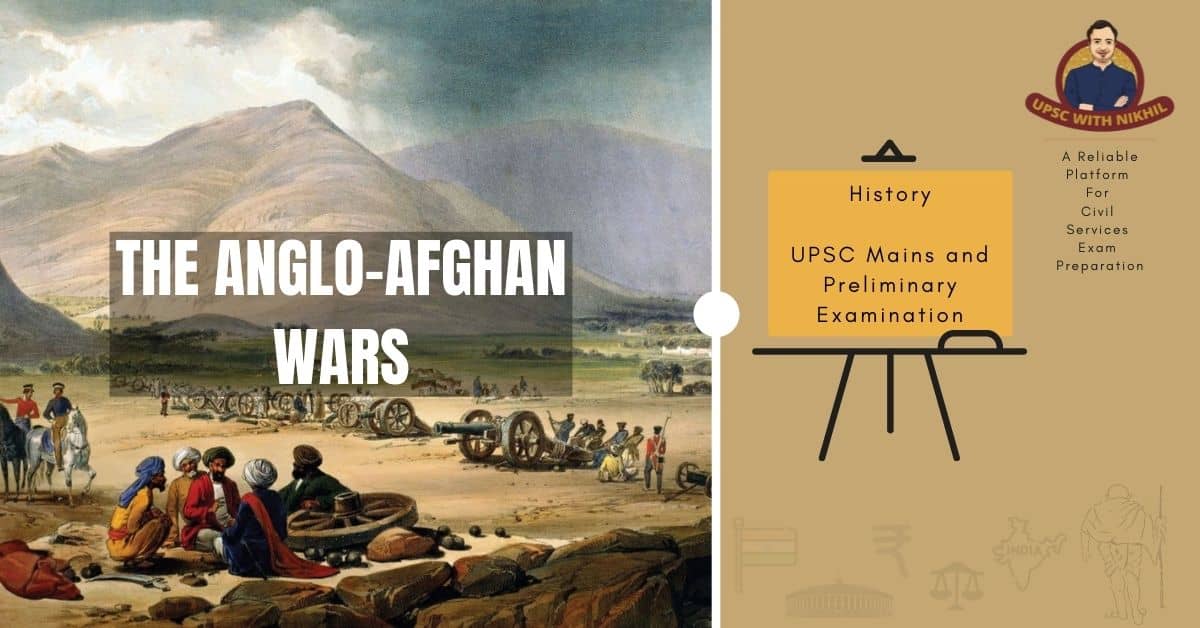
The British Indian Government fought two wars with Afghanistan before normalising relations with the Afghan government. During the nineteenth century, Indo-Afghan relations became inextricably linked to the Anglo-Russian rivalry. Britain was expanding its colonial power in West, South, and East Asia, while Russia was growing in Central Asia and looking to expand its territorial control into West and East Asia.
• Throughout Asia, the two imperialisms openly clashed. In fact, the Crimean War was fought in 1855 by Britain, France, and Turkey in an alliance against Russia.

• Throughout the 19th century, the British rulers of India were concerned that Russia would attack India via Afghanistan and the country's north-western border. As a result, they desired to keep Russia at a safe distance from the Indian border.
• From a geographical standpoint, Afghanistan was placed in a critical position for the British. It could be used as a forward base outside of India's borders to monitor Russia's potential military threat while also promoting British commercial interests in Central Asia.
• When the Whigs came to power in Britain in 1835 and Lord Palmerston was appointed Foreign Secretary, British policy toward Afghanistan became more active.
• Afghanistan's politics have been in flux since the early nineteenth century. Dost Muhammad Khan (Afghanistan's ruler) had achieved some stability, but he was constantly threatened by internal and external enemies such as –

a. In the north, Dost Muhammad faced internal uprisings as well as the threat of Russian invasion;
b. At Kandahar, one of his brothers challenged his power in the south;
c. Maharaja Ranjit Singh had occupied Peshawar in the east, and the English lay beyond him;
d. Enemies were stationed in Herat, and the Persian threat loomed large in the west.
• Doesn't As a result, Muhammad Khan was in desperate need of powerful allies. He also desired some sort of alliance with the Government of India, given his high regard for English strength.
• The Russians tried to persuade Dost Mohammad Khan to change his mind, but he refused. While he was discouraging the Russian envoy, he was friendly with Captain Burns, the British envoy. However, he was unable to obtain adequate terms from the British, who were only willing to offer verbal sympathy.
• The British desired to weaken and eliminate Russian influence in Afghanistan, but they did not want a powerful Afghanistan. They wanted to keep her country weak and divided so that they could control it easily.
• Lord Auckland, the Indian Governor-General, proposed a subsidiary-based alliance to Dost Muhammed. Dost Muhammed desired to be an equal ally of the British Indian Government, not one of its puppets or subordinate allies. After failing to gain the friendship of the British, Dost Muhammad reluctantly turned to Russia.
THE FIRST AFGHAN WAR
• Auckland has now decided to replace Dost Mohammed with a subordinate ruler who is friendlier. His gaze was drawn to Shah Shuja, who had been deposed from the Afghan throne in 1809 and had been living as a British pensioner in Ludhiana since then.
• On June 26, 1838, the Indian Government, Maharaja Ranjit Singh, and Shah Shuja signed a treaty in Lahore (three allies) in which the first two promised to assist Shah Shuja in gaining power in Afghanistan in exchange for Shah Shuja promising not to enter into any foreign state negotiations without the permission of the British and Punjab governments.
• In February 1839, the three allies launched an attack on Afghanistan. Ranjit Singh, on the other hand, stayed put and never ventured beyond Peshawar. Not only did the British forces have to take the lead, but they also had to do all of the exhausting fighting.
• Bribes had already won over the majority of Afghan tribes. On the 7th of August 1839, Kabul fell to the English, and Shah Shuja was immediately installed on the throne.
• The Afghan people despised and despised Shah Shuja, especially since he had returned with the aid of foreign bayonets. The Afghani people despised British meddling in their affairs. Gradually, patriotic, pro-freedom Afghans became enraged, and Dost Muhammed and his supporters began harassing the British army.
• In November 1840, Dost Muhammed was apprehended and deported to India as a prisoner. However, public outrage grew, and more and more Afghan tribes rose up in revolt. Then, on November 2, 1841, an uprising broke out in Kabul, and the tenacious Afghans attacked the British forces.
• The British were forced to sign a treaty with the Afghan chiefs on December 11, 1841, in which they agreed to evacuate Afghanistan and restore Dost Mohammed.
• The Afghans were attacked all along the way as the British forces withdrew. Only one man out of 16,000 made it to the border alive, with a few others surviving as prisoners.
• The entire Afghan mission was a complete failure. It turned out to be one of the greatest misfortunes for the British forces in India. A new expedition has been organised by the British Indian Government. On September 16, 1842, Kabul was retaken. But it had learned its lesson well, and after avenging its recent humiliation and defeat, it reached an agreement with Dost Mohammed in which the British evacuated Kabul and recognised him as Afghanistan's independent ruler.
Policy of Non-Interference
• In 1855, Dost Mohammed and the Government of India signed a treaty of friendship, ushering in a new period of Anglo-Afghan friendship. The two governments agreed to keep their relations friendly and peaceful, respect each other's territories, and refrain from interfering in each other's internal affairs.
• Dost Mohammed also agreed to be "the friend of the East India Company's friends and the enemy of the East India Company's enemies?" During the Revolt of 1857, he remained loyal to the treaty and refused to assist the rebels.
• After 1964, Lord Lawrence and his two successors pushed hard for a policy of non-interference. After Russia's defeat in the Crimean War, it turned its attention to Central Asia again; however, the British continued to strengthen Afghanistan as a powerful buffer.
• The British provided aid and assistance to the Amir of Kabul in order to help him discipline his internal rivals and maintain his independence from foreign enemies. The Amir was thus prevented from aligning himself with Russia through a policy of non-interference and occasional assistance.
SECOND AFGHAN WAR
• The policy of non-interference, on the other hand, did not last long. There was a resurgence of imperialism all over the world from 1870 onwards. The rivalry between the United Kingdom and Russia was also heightened.
• The British government was once again interested in Central Asia's commercial and financial penetration. In the Balkans and West Asia, Anglo-Russian ambitions clashed more openly than ever.
• British statesmen considered bringing Afghanistan under direct political control once more in order to use it as a base for British expansion in Central Asia.
• London told India's government to turn Afghanistan into a subsidiary state who’s foreign and defence policies would be firmly under British control.
• Sher Ali, the Afghan ruler or Amir, was well aware of the Russian threat to his independence, and he was eager to work with the British to eliminate any threat from the north. He offered India a defensive and offensive alliance against Russia in exchange for a promise of extensive military aid in the event of a conflict with internal or external enemies.
• The Indian government has refused to make any such unconditional and reciprocal commitment. Instead, it demanded the unilateral right to maintain a British mission in Kabul and control over Afghanistan's foreign relations.
• When Sher Ali refused to comply, his sympathies were labelled as anti-British and pro-Russian. “I will never allow him to become a tool in the hands of Russia,” declared Lord Lytton, who had arrived in India as Governor-General in 1876. It would be my responsibility to break such a tool before it could be used.”
• Lytton proposed that Afghanistan's power be gradually disintegrated and weakened. In 1878, a new attack on Afghanistan was launched in order to compel the Amir to accept British terms. In May 1879, Sher Ali's son, Yakub Khan, signed the Treaty of Gandamak, which gave the British everything they wanted.
• They gained control over Afghanistan's foreign policy, as well as certain border districts and the right to keep a Resident in Kabul. The British triumph was fleeting. Afghans' national pride had been shattered, and they rose up once more to defend their independence.
• On September 3, 1879, rebellious Afghan troops attacked and killed the British Resident, Major Cavagnari, and his military escort. Afghanistan was invaded and occupied once more. In 1880, Britain's government changed, and Lytton was replaced by Lord Ripon, a new Viceroy.
• Ripon quickly reversed Lytton's aggressive policy, returning to a non-interference policy in the internal affairs of a strong and friendly Afghanistan. Ripon proclaimed Abdur Rahman, Dost Mohammed's grandson, as Afghanistan's new ruler.
• In exchange for Abdur Rahman agreeing not to maintain political relations with any power other than the British, the demand for the maintenance of a British Resident in Afghanistan was withdrawn.
• The Indian government also agreed to pay Amir an annual stipend and to support him in the event of foreign aggression. The Amir of Afghanistan lost control of his foreign policy and became a dependent ruler as a result.

THIRD ANGLO-AFGHAN WAR
• The First World War and the Russian Revolution of 1917 created a new situation in Anglo-Afghan relations.
• The war inflamed anti-British sentiment in Muslim countries, and the Russian Revolution sparked new anti-imperialist sentiment in Afghanistan, as well as throughout the world.
• The abolition of Imperial Russia also removed the constant threat of aggression from the northern neighbour, which had forced successive Afghan rulers to seek support from the British.
• Afghans are now demanding complete independence from British rule. On February 20, 1919, Habibullah, who had succeeded Abdul Rahman as Amir in 1901, was assassinated, and his son Amanullah, the new Amir, declared open war on British India.
• A treaty brought peace in 1921, and Afghanistan regained its foreign policy independence.