

The British War With Nepal
A free country's foreign policy is fundamentally different from that of a country ruled by a foreign power. It is based on the needs and interests of the country's people in the former case, but it is primarily in the interests of the ruling country in the latter. In the case of India, the British government dictated the foreign policy of the Indian government.
Under British rule, India established new relationships with its neighbours. This was due to a combination of two factors.
a. The development of modern communication technologies, as well as the country's political and administrative consolidation, compelled the Indian government to reach out to the country's natural and geographical borders. This was necessary for both defence and internal cohesion. This inevitably resulted in some border clashes. Unfortunately, the Indian government has occasionally crossed natural and traditional boundaries.

b. The other factor was India's government's foreign character.

THE BRITISH GOVERNMENT HAD TWO MAJOR AIMS IN ASIA AND AFRICA:
1. The expansion of British commerce and other economic interests in Africa and Asia
2. The protection of its priceless Indian empire.
Both of these goals resulted in British territorial conquests outside of India's natural borders. Furthermore, these goals pitted the British government against other European imperialist nations seeking to expand their territorial possessions and trade in Afro-Asian lands. The British Indian government's desire to defend their Indian empire, promote British economic interests, and keep other European powers at arm's length from India often led to aggression against India's neighbours.
To put it another way, India's relations with its neighbours were ultimately determined by the needs of British imperialism during the period of British dominance. However, while Indian foreign policy benefited British imperialism, India bore the cost of its implementation. India had to fight many wars against its neighbours in order to serve British interests; Indian soldiers had to shed blood, and Indian taxpayers had to foot the bill.
THE WAR WITH NEPAL
The British desire to extend their Indian Empire to its natural geographical border drew them into conflict with the northern Kingdom of Nepal, first and foremost.
• The Gurkhas, a Western Himalayan tribe, conquered the Nepal valley in 1768.The Gurkhas had gradually built up a powerful army and spread their influence from Bhutan to the Sutlej River in the west.
• The Gurkhas began to push south from the Nepal Tarai. In the meantime, Gorakhpur was conquered by the British in 1801. This pitted the two expanding powers against each other across a hazy border.
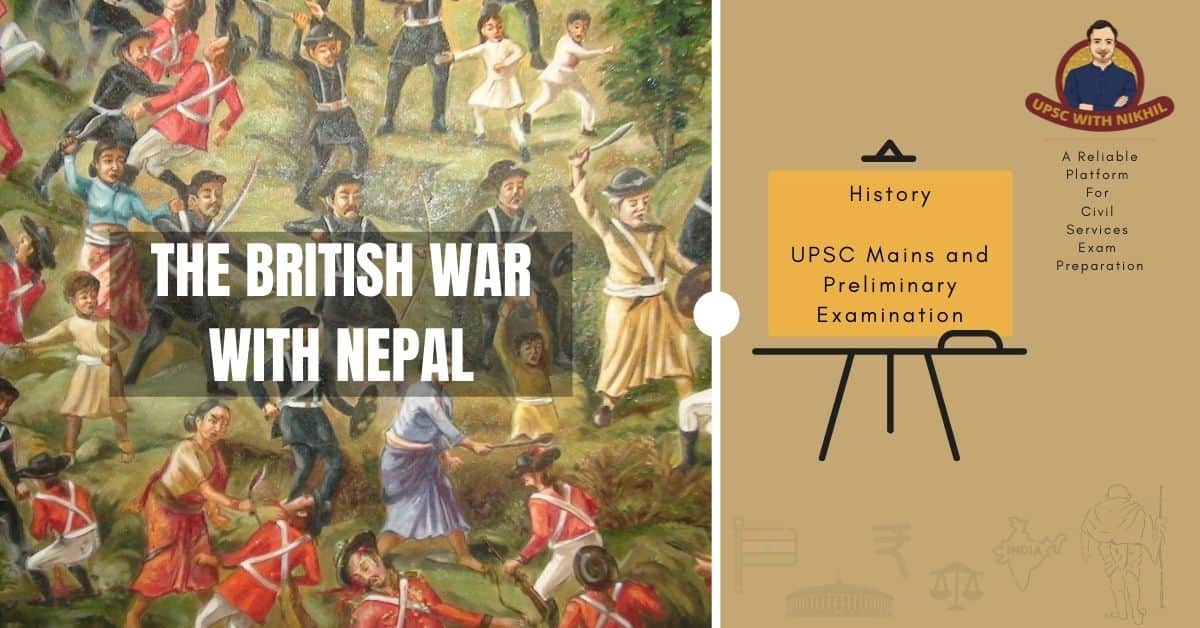
• In October 1814, a border clash between the two countries' border police escalated into open war.
• British officials anticipated a simple walk-over, especially since their army was attacking all along the 600-mile border. The Gurkhas, on the other hand, fought back with vigour and bravery. The British armies were repeatedly defeated.
• The Gurkhas, on the other hand, would not be able to survive in the long run. In terms of men, money, and materials, the British were far superior.
• They occupied Kumaon in April 1815 and forced the brilliant Gurkha Commander Amar Singh Thapa to surrender on May 15th.
• The Nepalese government was now compelled to make peace. However, the peace talks quickly fell apart. The British demanded that a Resident be stationed in Kathmandu, Nepal's capital, but the Nepalese government refused.
• It was realised that accepting a British subsidiary alliance amounted to signing away Nepal's independence. Early in 1816, fighting resumed.
• British forces achieved significant victories and got within 50 miles of Kathmandu. In the end, the Nepalese government was forced to sign a peace treaty with the British (known as the Treaty of Sugauli).
• A British Resident was accepted by the Nepalese government. It gave up the districts of Garhwal and Kumaon, as well as its claims to the Tarai. It also pulled out of Sikkim.

The British gained many benefits from the agreement, including:
a. Their Indian Empire had now reached the Himalayas
b. They gained improved trade facilities with Central Asia
c. They also secured land for important hill towns like Simla, Mussoorie, and Nainital; and
d. By enlisting in large numbers, the Gurkhas bolstered the British-Indian army.
Following that, the British had friendly relations with Nepal. Both sides in the 1814 War had learned to respect each other's fighting abilities and preferred to live in peace.