

The Impact Of Colonial Rule On Indian Peasants
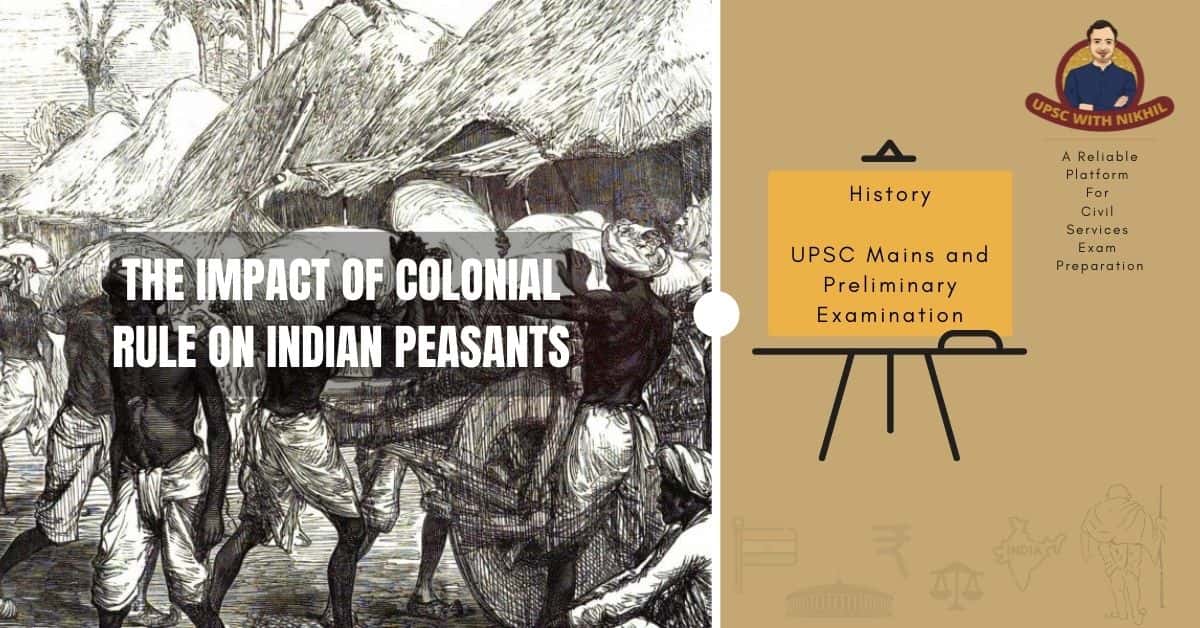
It's worth considering the consequences of colonial exploitation of Indian peasants. The agrarian structure was transformed and the peasantry was impoverished as a result of colonial economic policies, the new land revenue system, colonial administrative and judicial systems, and the ruin of handicraft leading to land overcrowding.
• The peasants were left to the mercy of the zamindars in the vast zamindari areas, who rack-rented them and forced them to pay illegal dues and perform beggar. The government levied heavy land revenue in Ryotwari areas.
• The peasants were forced to borrow money from moneylenders as a result of this. The actual cultivators were gradually reduced to the status of tenants-at-will, share-croppers, and landless labourers, while their lands, crops, and cattle passed into the hands of landlords, trader-moneylenders, and wealthy peasants over large areas.
• When the peasants had enough, they rebelled against oppression and exploitation; and, whether their target was the indigenous exploiter or the colonial administration, they discovered that the colonial state was their real enemy once the barriers were removed.

• Individuals and small groups who found that collective action was not possible but their social situation was becoming intolerable turned to crime as a form of elemental protest.
• Many dispossessed peasants turned to robbery, dacoits, and social banditry as a means of avoiding starvation and social degradation.

THE IMPACT OF PEASANT STRUGGLES
• After 1857, there was a noticeable change in the nature of peasant movements. Peasants emerged as the main force in agrarian movements after princes, chiefs, and landlords were crushed or co-opted.
• They were now fighting for their own demands, which were almost entirely economic in nature, and against their immediate foes, foreign planters and indigenous zamindaris and moneylenders. Their struggles were focused on achieving specific and limited goals and redressing specific grievances.
• They didn't set colonialism as their goal. Their goal was also not to end the system of their subordination and exploitation. They had no intention of turning the world on its head.'
• These movements' territorial reach was also limited. They were confined to specific areas with no means of communication or interconnection.
• They also lacked long-term organisation and struggle continuity. Once a movement's specific goals were met, its organisation, as well as the peasant solidarity that had grown up around it, disbanded and vanished. Thus, the Indigo strike, the Pabna agrarian leagues, and the Deccan ryots' social-boycott movement left no successors.
• As a result, these movements never threatened or even undermined British supremacy. After 1857, peasant protest was frequently an instinctive and spontaneous response of the peasantry to its social situation.
• Excessive and intolerable oppression, undue and unusual deprivation and exploitation, and a threat to the peasant's existing, established position all contributed to the uprising.
• The peasant usually rebelled only when thye felt that the status quo could no longer be maintained.
• They was also influenced by strong notions of legitimacy, of what was and wasn't justifiable. That is why they opposed eviction and exorbitant rent increases rather than land ownership or landlordism. They did not object to paying interest on the money he had borrowed; however, they fought back against the moneylender's deception and chicanery, as well as when the latter went against tradition by taking his land.
• They did not dispute the state's right to collect a land tax, but they objected when the level of taxation exceeded all precedent.
• They did not object to the foreign planter becoming they is zamindar, but he did object when the planter took away his ability to choose which crops to grow and refused to pay him a fair price for his harvest.
• In addition, the peasant developed a strong understanding of his legal rights and asserted them both inside and outside of the courts. And if extra-legal means or manipulation of the law and law courts were used to deprive him of his legal rights, he retaliated with extra-legal means of his own.
• They was frequently under the impression that the legally-constituted authority had approved his actions or at the very least supported his claims and cause. He acted in the name of this authority, the sarkar, in all three movements discussed here.
• The Indian peasants demonstrated great courage and a spirit of sacrifice in these movements, as well as remarkable organisational abilities and a solidarity that cut across religious and caste lines.
• They were also successful in obtaining significant concessions from the colonial government. Without being directly challenged, the latter, too, was willing to compromise and soften the harshness of the agrarian system while remaining within the confines of the colonial economic and political structure.
• The treatment of post-1857 peasant rebels by the colonial regime was qualitatively different from that of participants in civil rebellions, the Revolt of 1857, and tribal uprisings that directly challenged colonial political power.

Some flaws:
• The lack of an adequate understanding of colonialism of colonial economic structure and the colonial state as well as the social framework of the movements themselves was a major weakness of the 19th century peasant movements.
• Peasants in the nineteenth century lacked a new ideology as well as a new social, economic, and political programme based on an examination of the newly formed colonial society. Their struggles, no matter how violent, took place within the confines of the old social order.
• They lacked a positive vision of an alternative society, one that would bring people together in a common struggle on a regional and national scale, as well as aid the development of long-term political movements.
• In the absence of such a radical ideology, programme, leadership, and struggle strategy, it was relatively easy for the colonial state to reach a compromise and calm down the rebellious peasants by granting some concessions on the one hand, and to suppress them with full force on the other.
Conclusion
• This are necessitated efforts for modern intelligentsia, which was still in its infancy.
• The majority of these flaws were overcome in the twentieth century, when peasant discontent was merged with general anti-imperialist discontent, and peasant political activity became part of the larger anti-imperialist movement.
• Of course, peasant participation in the larger national movement not only strengthened the fight against the foreigner, but it also allowed them to organise powerful struggles around their class demands and form modern peasant organisations at the same time.