

The Indigo Revolt Of 1859-60
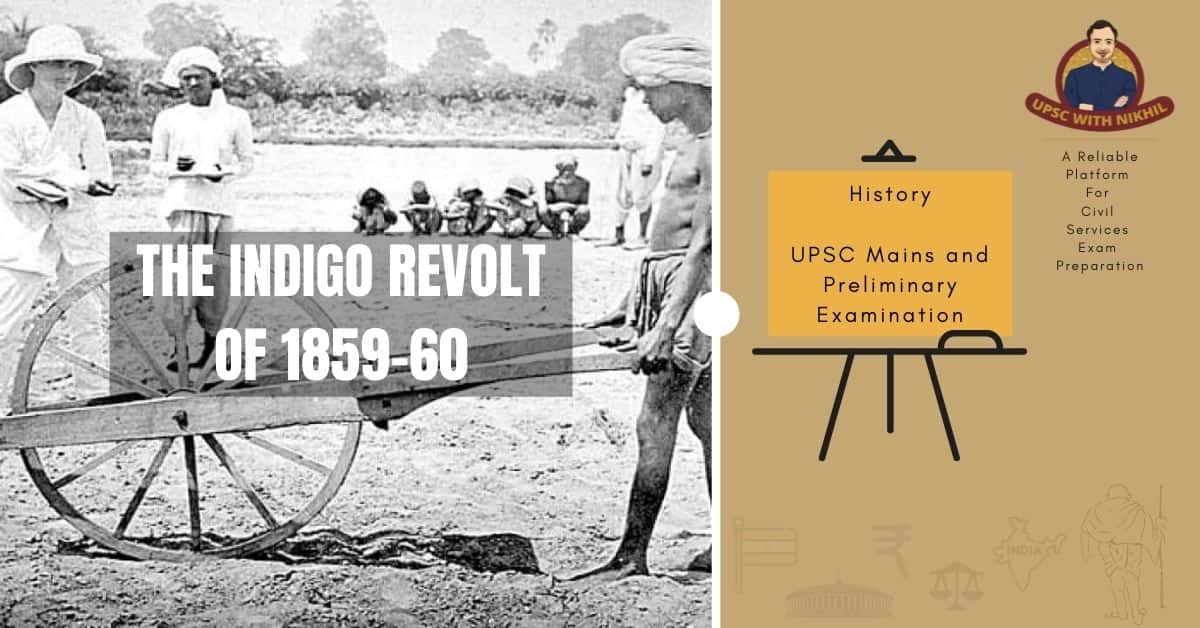
The Indigo Revolt of 1859-60 was the most militant and widespread of the peasant movements. The tenants were forced to grow indigo, which was processed in factories set up in rural (mofussil) areas by the indigo planters, who were almost all Europeans. Indigo was grown under an extremely oppressive system from the start, resulting in significant losses for the cultivators.

Position of planters:
a. Planters forced peasants to take a pittance as a down payment and enter into sham contracts. The indigo plants were purchased for a fraction of the market price. Whether or not the peasant wanted to devote his land and labour to more lucrative crops like rice, he was forced to grow indigo on the best land he had.
b. He was even cheated out of the due low price at the time of delivery. He also had to pay bribes to the planter's officials on a regular basis.
c. He was compelled to take a loan. He was frequently unable to repay it, and even if he could, he was not permitted to do so. The planters used the advance to force him to continue cultivating indigo.

d. The planters used a reign of terror to coerce the peasants because enforcing forced and fraudulent contracts through the courts was difficult and time-consuming.
e. The planters used kidnapping, illegal confinement in factory godowns, flogging, attacks on women and children, cattle theft, looting, house burning and demolition, and destruction of crops and fruit trees as some of their methods. For this purpose, they hired or maintained bands of lathyals (armed retainers).
• The planters were also above the law in practise. The magistrates, most of whom were Europeans, favoured the planters with whom they dined and hunted on a regular basis, with a few exceptions. Those who attempted to be fair were quickly transferred.
Causes:
• Bengali indigo growers' dissatisfaction reached a boiling point in the autumn of 1859, when their case appeared to be supported by the government.
• Misreading an official letter and exceeding his authority, Hem Chandra Kar, Deputy Magistrate of Kalaroa, published on 17 August a proclamation to policemen that ‘in case of disputes relating to Indigo Ryots, they (ryots) shall retain possession of their own lands, and shall sow on them what crops they please, and the Police will be careful that no Indigo Planter nor anyone else be able to interface in the matter.
• The news of Kar's proclamation spread throughout Bengal, and peasants believed that the time had come to overthrow the despised system.
• At first, the peasants attempted to obtain redress through peaceful means. They organised peaceful demonstrations and sent numerous petitions to the authorities. Their rage erupted in September 1859, when they asserted their right not to grow indigo under duress and stood up to the planters' and their lathiyals' physical pressure, which was backed up by the police and the courts.
• The beginning was made by the ryots of Govindpur village in Nadia district, who gave up indigo cultivation under the leadership of Digambar Biswas and Bishnu Biswas, ex-employees of a planter. When the planter sent a band of 100 lathyals to attack their village on September 13, they organised a counter-offensive armed with lathis and spears and fought back. Peasant uprisings and indigo strikes quickly spread to other parts of the country.
• The peasants refused to take advances or sign contracts, vowed not to sow indigo, and fought back with whatever weapons they could find — spears, slings, lathis, bows and arrows, bricks, bel-fruit, and earthen-pots — against the planters' attacks (thrown by women).
• In the spring of 1860, the indigo strikes and disturbances erupted once more, this time encompassing all of Bengal's indigo districts. Hundreds of peasants attacked factory after factory, and village after village bravely defended itself.
• Attempts by the police to intervene and arrest peasant leaders were frequently met with attacks on police officers and police stations. The planters then used another weapon, their zamindari abilities, to attack. They threatened the disobedient ryots with eviction or rent increases.
• The ryots retaliated with a rent strike. They refused to pay the increased rents and physically resisted eviction attempts. They also learned to use the legal system to enforce their rights over time.
• They banded together and raised funds to fight court cases brought against them, as well as taking legal action against the planters on their own. They also used social boycott as a weapon to compel a planter's servants to leave him.
• Eventually, the planters were unable to withstand the ryots' united resistance and began to close their factories. By the end of 1860, indigo cultivation had all but disappeared from Bengal's districts.

Reason for success:
• The ryots' incredible initiative, cooperation, organisation, and discipline were key factors in the Indigo Revolt's success. Another thing that stood out was the complete unity of Hindu and Muslim peasants.
• The movement was led by the wealthier ryots, as well as petty zamindars, moneylenders, and former planter employees in some cases.
• The role of Bengal's intelligentsia, which organised a powerful campaign in support of the rebellious peasantry, was a significant feature of the Indigo Revolt. It ran newspaper campaigns, held mass meetings, drafted memoranda on peasants' grievances, and backed them up in court battles.
• Harish Chandra Mukherji, editor of the Hindoo Patriot, played a particularly important role in this regard. He regularly published reports from his rural correspondents on planter oppression, official partisanship, and peasant resistance. He wrote with zeal, rage, and a thorough understanding of the issue, which he elevated to a high political level.
• Neel Darpan, a play by Din Bandhu Mitra, became famous for vividly portraying the oppression of the planters.
• The role of the intelligentsia in the Indigo Revolt had a lasting impact on the new generation of nationalist intellectuals. They had backed a popular peasant movement against foreign planters during their early political years. This was done to establish a long-term tradition for the national movement.
• Another group that actively supported the indigo ryots in their struggle were missionaries. The government's response to the Revolt was more measured than it had been in the past in the face of civil wars and tribal uprisings. It had just recovered from the horrors of the Santhal uprising and the 1857 Revolt. It was also able to see the peasantry's changing mood over time and was influenced by the intelligentsia's and missionaries' support for the Revolt. It established a commission to investigate the issue of indigo cultivation. The evidence presented to the Indigo Commission, as well as the commission's final report, revealed the coercion and corruption that underpin the entire indigo cultivation system.
• As a result, the worst abuses of the system were reduced. In November 1860, the government issued a notice stating that ryots could not be forced to sow indigo and that all disputes would be resolved through legal means.
• The planters, on the other hand, were already shutting down factories because they believed they couldn't make their businesses pay without resorting to force and fraud.