

The Saiyid Brothers’ Struggle For Wizarat
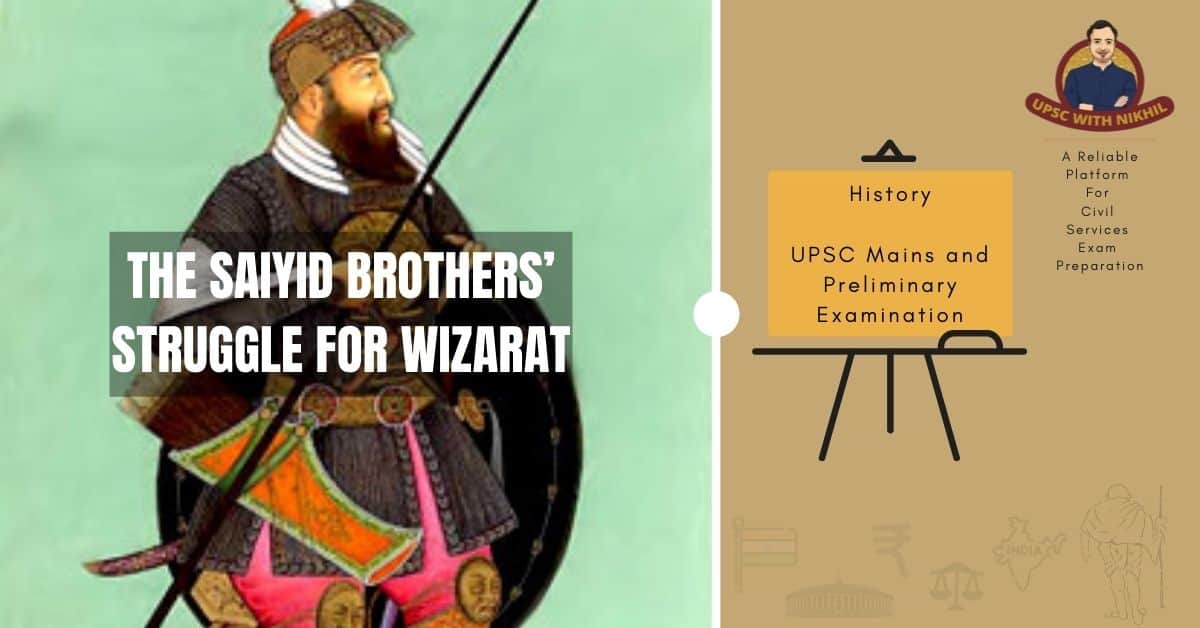
Since 1707, Farrukh Siyar, Azim-ush-second Shan's son, had served as his father's deputy in Bengal. He had been summoned to the court, possibly in anticipation of a civil war following Bahadur Shah's death in 1711. He had been in Patna for a few months when he learned of Bahadur Shah's death and immediately declared his father, Azim-ush-Shan, to be the new king.

• Hussain Ali Baraha, who had served as the deputy of Azim-ush-Shan in Bihar since 1708 and had clashed with Farrukh Siyar on a number of issues since his arrival in Patna, was not pleased with theprince's hasty action. When news of Azim-ush-defeat Shan's and death in Lahore arrived, Husain Ali wanted to retreat, but the Emperor's mother persuaded him not to because it would be a matter of eternal shame for him.
• Farrukh Siyar was also promised a high position if he ascended the throne. However, relations between the two remained strained, with Husain Ali distrusting Farrukh Siyar, who had earned a reputation for low-level cunning after capturing Fort Rohtas with the help of a farman and promising the commandant's safety, but then breaking the promise after he had vacated the fort.
• By November 1712, Farrukh Siyar and Husain Ali's combined armies had arrived in Allahabad, where Abdullah Khan, Husain Ali's elder brother and Azim-ush-deputy Shan's in the province, had joined them. Abdullah Khan rose to the top of the coalition quickly, and he used his clout to help Husain Ali and Farrukh Siyar resolve their feud.
• Farrukh Siyar's victory at Agra in January 1713 was entirely due to the Saiyid Brothers' efforts. As a result, Farrukh Siyar had no choice but to appoint Abdullah Khan as wazir and Husain Ali as MirBakhshi. They were promoted to the rank of 7000/7000, given governorships of Multan and Bihar, respectively, and given deputies to govern them.
• Abdullah Khan's maternal uncle, Saiyid Muzaffar Khan Baraha, was appointed governor of Ajmer, and a few Saiyid relatives and kinsmen were admitted to mansabs. Aside from that, the Saiyids did not claim any special status for their relatives.

• They were actually eager to appease and win over the old Alamgiri and Bahadur Shahi nobles. At the outset, it was decided that all Alamgiri nobles would be confirmed in their previous ranks, and that any promotions of 300 or more in the zat rank given by Bahadur Shah would be scrutinised.
• Chin Qulich Khan was given the mansab of 7000/7000 and the title of Nizam-ul-Mulk, as well as the power to choose the lands that would be allotted in jagir to him and his followers, and to suggest the mansabs that would be granted to the chief zamindars there, such as the Marathas and others.
• Abdullah Khan used to refer to Nizam-ul-Mulk as his "elder brother," and he would pay him a visit and exchange valuable gifts before departing for the Deccan. Muhammad Amin Khan, Nizam-ul-cousin, Mulk's was appointed second bakhshi and given the title of Itimad-ud-Daulah.
• Abdus Samad Khan, who had served as Zulfiqar Khan's chief lieutenant in the Lahore civil wars, was promoted to the rank of 7000/7000 and appointed governor of the city. However, the Saiyids' efforts to win over the old nobles were only partially successful.
• The Saiyids were viewed as Hindustani upstarts by many of the old nobles who were envious of them. The Saiyids attempted to follow a liberal, broad policy as well. Jizyah had been abolished at the request of Husain Ali while Farrukh Siyar was still in Bihar. This order was repeated six days after Jahandar Shah's defeat at Agra. Pilgrim taxes were abolished in a number of places, and restrictions on Hindus riding palkis and Arabi and Iraqi horses, which had been imposed by Aurangzeb and continued by Bahadur Shah, were eased and eventually abolished.
• The Saiyids also wanted to make amends with the Rajputs.
• Thus, Rana Sangram Singh II was granted a mansab of 7000/7000 with 8 crore dams in inam at their request. Farrukh Siyar received letters of congratulations from Jai Singh and Ajit Singh, but they did not come to pay personal allegiance.
• They reiterated their previous demands for the grant of high mansabs and appointment to the subahs of Malwa and Gujarat, respectively, through their wakils. Farrukh Siyar, who wanted to teach the Rajputs a lesson, was not pleased with this.

• He was especially enraged by Ajit Singh, who had assassinated two of Indra Singh's sons, both of whom were Mughal mansabdars. Jai Singh and Ajit Singh were promoted to the rank of 7000/7000, but Jai Singh was appointed governor of Malwa and Ajit Singh to Thatta in order to disrupt the Rajput Rajas' alliance.
• Ajit Singh refused to go to Thatta, despite Jai Singh's moves towards Malwa, and Husain Ali was asked to lead an expedition against him.
• Early in January 1714, Husain Ali led a large army against Ajit Singh. Meanwhile, the Saiyids' relationship with Farrukh Siyar had deteriorated to the point where Farrukh Siyar sent Ajit Singh secret letters promising rewards if he could defeat and kill the Mir Bakhshi.
• Husain Ali, who had maintained close and cordial relations with the Rajput Rajas, was quickly informed of these moves. After a few months of campaigning, during which Husain Ali was aided by a contingent of 4000 sawars dispatched by the Rana, Ajit Singh agreed to marry his daughter to Farrukh Siyar, send his son Abhai Singh to the court with the Mir Bakhshi, give peshkash, and accept appointment to Thatta.
• According to a secret codicil, Ajit Singh would be appointed governor of Gujarat as soon as he marched a few stages towards Thatta to demonstrate his loyalty. Even without the Emperor's formal approval, Husain Ali personally issued a rescript appointing Ajit Singh to Gujarat.