

The Wizarat Of Muhammad Amin & Nizam-ul-mulk
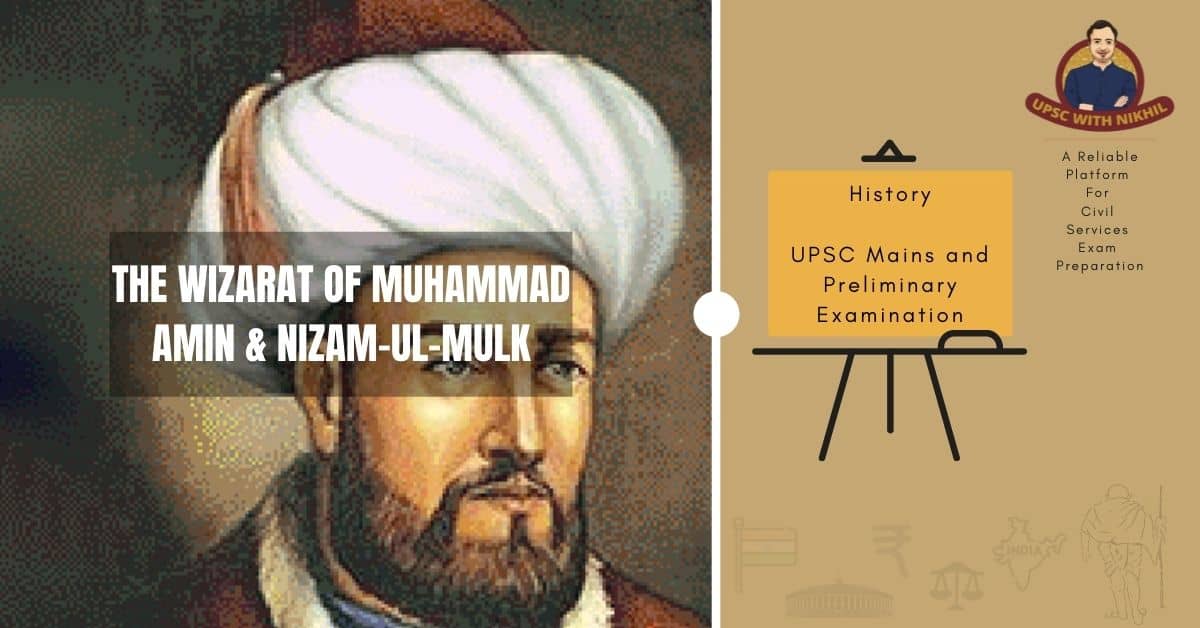
M. Amin Khan was made wazir with the title of Itimad-ud-Daulah, a mansab of 8000-8000 du-aspa, sih-aspa, and the absentee governorship of Multan after the Saiyids fell. His son, Qamaruddin Khan, was given the rank of second bakhshi and the faujdari of Moradabad, which was the size of a subah.
• He was also made darogha of the Ghusalkhana, which controlled access to the Emperor, and darogha of the Ahadis, which controlled access to the Emperor (gentlemen trooper). Khan-i-Dauran was promoted to chief Bakhshi, and Saadat Khan, who was involved in Husain Ali's assassination, was given the governorship of Awadh.

• Abdus Samad Khan kept Lahore and added Kashmir to his son's name.
• Muhammad Amin continued the Saiyids' policy of making the wazir the true centre of affairs and of courting Rajputs, Marathas, and Hindus in general. As a result, Muhammad Amin Khan showed no desire to loosen the wazir's grip on the Emperor.
• According to a contemporary, Warid, Muhammad Shah's only claim to the throne and the crown was to sit on it. The Emperor was terrified of the wazir, so he gave him complete power.
• Due to the opposition of Raja Jai Singh and Raja GirdharBahadur, a proposal to revive jizyah was dropped.
• The agreement with the Marathas for the grant of chauth and sardeshmukhi of the Deccan was confirmed by the grant of new sanads, which Nizam-ul-Mulk had agreed to in a secret meeting with Peshwa Baji Rao soon after the Saiayids' downfall.
• Ajit Singh was expelled from Gujarat for mismanagement, but the wazir was suspected of wanting him to return to Gujarat or Ajmer. However, Muhammad Amin Khan died after a year and three months (Jan. 1721). The way was now clear for Nizam-ul-Mulk to take over as wizarat. Nizam-ul-Mulk was not eager to take office, and even after receiving royal summons, he went to Karnataka to settle his affairs. When Nizam-ul-Mulk arrived in Delhi in February 1722, almost a year after Muhammad Amin's death, he discovered that the administration had deteriorated and been made worse by factional strife at the court.

• Nizam's true motivation was to keep the Deccan and, if possible, to keep Malwa and add Gujarat to it. As a result, he had Gujarat transferred to his son, Ghaziuddin Khan, and moved his army to Gujarat to depose the incumbent, Haider Quli Khan. He met Baji Rao for the second time on the way, this time near Jhabua in Malwa.
• Baji Rao had led a large force into Malwa. Mubariz Khan, Nizam-ul-deputy Mulk's in the Deccan, had renounced the treaty with the Marathas for the grant of chauth and sardeshmukhi. Nizamul-tirade Mulk's against the Marathas and Rajputs was subject to change when it suited his interests, as evidenced by the secret agreement between Nizamul-Mulk and Baji Rao.
• Nizam returned to Delhi after ousting Haider Quli from Gujarat. Nizam has now proposed a plan to reform the administration. Its main point was that, as in Aurangzeb's time, only fit nobles and soldiers should be employed, that the jagirs should be redistributed, and that the khalisa lands given injagir should be resumed.
• He also advocated for a ban on crown-land farming and condemned bribe-taking. He desired the restoration of jizyah to its former glory during Aurangzeb's reign.

• Nizam-ul-attempt Mulk's to rally the old nobles to his side in this manner failed miserably. Any review of the jagir holdings was strongly opposed by the new nobles, including the Hindustanis who had become entrenched in the administration. They pounced on Nizam's proposal to resurrect jizyah, calling it "inopportune." Even Nizam's cousin, Abdus Samad Khan, governor of Lahore, was opposed to the revival of jizyah.
• It's unclear how sincere Nizam-ul-Mulk was about putting his reform plan into action. He left for his jagir in Moradabad in late 1723 for a "change of air," but returned to Malwa after hearing of renewed Maratha incursions into that rich and strategically located province.
• Nizam-ul-Mulk learned on his way to Malwa that he had been deposed in the Viceroyalty of the Deccan by his deputy, Mubariz Khan. The Emperor also attempted to enlist Shahu and some of the most powerful Maratha sardars against Nizam.
• Nizam-ul-Mulk defeated Mubariz Khan with the help of Maratha troops led by Baji Rao in a battle at Shakar Khera in October 1724, and the de facto independence of Haiderabad can be traced back to this battle. The Mughal empire was beginning to fall apart. The dynasty's and empire's defenders had completely reversed their roles and had become the primary agents of their demise.