

Third Burmese War (1885)
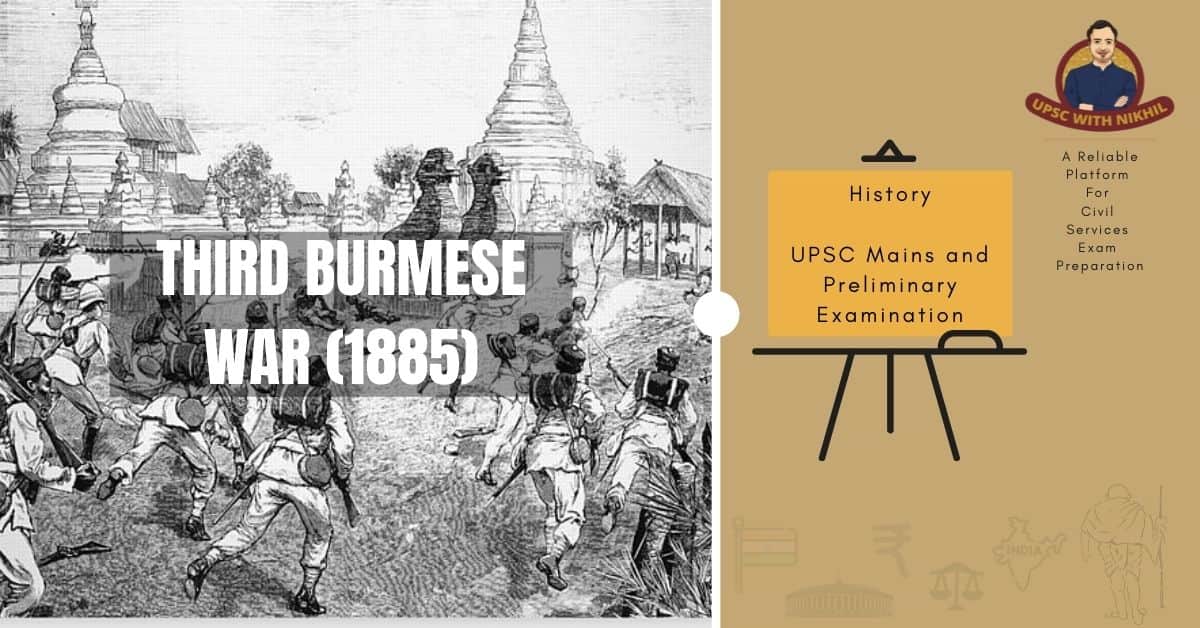
After the annexation of Pegu, relations between Burma and the United Kingdom remained peaceful for several years. The possibility of trade with China through Burma drew British merchants and industrialists in particular. There was a lot of pressure in Britain and Rangoon for the land route to Western China to be opened. Finally, in 1862, Burma agreed to sign a commercial treaty allowing British merchants to settle in any part of the country and to take their ships up the Irrawaddy River to China. Impatient with the Burmese government's restrictions on their trade and profits, British merchants began to press for stronger action against them. Many of them even demanded that Upper Burma be conquered by the British. In February 1882, the king was finally persuaded to abolish all monopolies.

CAUSES OF THIRD ANGLO-BURMESE WAR
The Burmese king and the British government disagreed on a number of other political and economic issues.
• In 1871, the British Government humiliated the king by stipulating that all dealings with him be handled by the Viceroy of India, as if he were merely the ruler of one of the Indian states. Another point of contention was the king's attempt to establish friendly relations with other European powers.
• A Burmese mission visited France in 1873 to try to negotiate a commercial treaty that would allow Burma to import modern arms, but the French government later refused to ratify the treaty due to British pressure. King Mindon died in 1878, and King Thibaw took his place.

• Under the guise of preventing King Thibaw's alleged cruelties, the British gave refuge to rival princes and openly interfered in Burma's internal affairs. As a result, the British claimed that they had the right to protect Upper Burma's citizens from their own king. Thibaw's desire to continue his father's policy of strengthening economic and political ties with France.
• In 1885, Thibaw and France signed a purely commercial treaty that allowed for trade. The British were envious of the growing influence of the French in Burma.
• British merchants feared that their French and American competitors would seize control of the lucrative Burmese market. British officials feared that forming an alliance with France would allow the king of Upper Burma to elude British control, or even lead to the establishment of a French dominion in Burma, jeopardising the security of their Indian Empire.
• In South-East Asia, the French had already established themselves as a major competitor of the British.
• They seized Annam (Central Vietnam) in 1883, laying the groundwork for their Indo-China colony. They were actively pursuing North Vietnam, which they conquered between 1885 and 1889, as well as Thailand and Burma in the west.
• The British chambers of commerce and British merchants in Rangoon pressed the willing British government to annex Upper Burma immediately.
IMMEDIATE CAUSE
• All that was required was a pretext for war. The Bombay-Burma Trading Corporation, a British company with a lease on Burma's teak forests, provided this. The Burmese government accused the Company of bribing local officials to extract more than double the amount of teak contracted for, and demanded compensation
• The British government, which had already prepared a military plan for the Upper Burma attack. Burma, saw this as an opportunity to make a number of demands on the Burmese government, including the requirement that the Viceroy of India be in charge of Burma's foreign relations. The Burmese government would have been unable to accept such demands without jeopardising the country's independence. On November 13, 1885, a British invasion was launched in response to its rejection.
• As a sovereign nation, Burma had every right to impose trade restrictions on foreigners. It had the same right to form friendly relations with France and import arms from anywhere.
• The Burmese government was unable to mount a successful counter-offensive against the British forces. The King was unprepared for war, incompetent, and unpopular. Court intrigues tore the country apart. There was a state of near-civil war.
• On November 28, 1885, King Thibaw surrendered, and his kingdom was quickly annexed by the Indian Empire.

FREEDOM STRUGGLE OF BURMA
• Following World War I, Burma experienced a strong modern nationalist movement. A broad boycott of British goods and administration was organised, with the demand for Home Rule being made.
• Burmese nationalists quickly allied with India's National Congress.
• In 1935, the British partitioned Burma from India in order to weaken the Burmese independence movement. Burmese nationalists were opposed to the move.
• During WWII, the Burmese nationalist movement rose to new heights under the leadership of U Aung San. Finally, on January 4, 1948, Burma gained independence.