

Zulfiqar Khan And Jahandar Shah (1712-13)
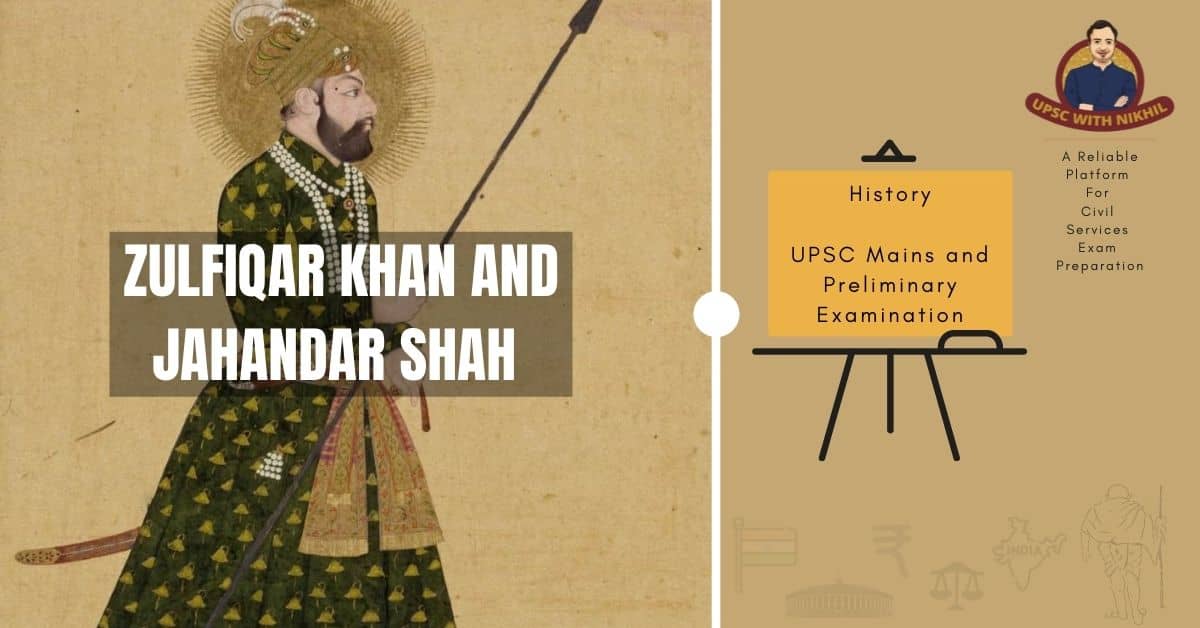
Following Bahadur Shah's death, the civil war among his sons was essentially a battle between Azim-ush-Shan, the most energetic prince with the most resources, and Zulfiqar Khan, the most powerful noble.
• To counter Azim-ush-Shan, Zulfiqar had forged an agreement with the other three princes in which the empire would be divided among them, but sikka and khutba would remain in the name of the eldest, Jahandar Shah.
• Zulfiqar, the common wazir, would be in charge of Jahandar Shah's court, with deputies in charge of the other courts.

• The idea of partitioning the empire is said to have come from Aurangzeb, and Bahadur Shah had promised to follow it before the Battle of Jaju and the battle with Kam Bakhsh. However, no one appears to have taken the suggestion seriously. Zulfiqar Khan wasted no time in defeating the other two brothers, Rafi-ush-Shan and Jahan Shah, after defeating Azim-ush-Shan thanks to his efforts and energy.
• Zulfiqar Khan became wazir almost by default after Jahandar Shah's accession to the throne of Lahore. He also kept the Viceroyalty of the Deccan, which he governed through Daud Khan, his deputy.
• He was given the rank of 10,000 / 10,000 du-aspa sih-aspa and the title of yar-wafadar, which was previously unheard of (faithful friend.). Asad Khan, his father, remained Wakil-i-Mutlaq and was given the governorship of Gujarat and a mansab of 12,000/12,000.
• Although Jahandar referred to him as "uncle" out of respect, Asad Khan was uninterested in public affairs and rarely visited the court. As a result, Zulfiqar Khan retained total power, and Jahandar Shah followed his advice.
• Zulfiqar Khan took advantage of his power and position to implement a broad liberal and inclusions policy. First and foremost, jizyah was abolished only nine days after Jahandar Shah's formal accession, at the request of Asad Khan. Although jizyah had been suspended in the Deccan by Aurangzeb for the duration of the war in 1704 and had largely fallen out of favour, it was asserted on a few occasions by Bahadur Shah.
• After Ajit Singh was forced to abandon it, jizyah was imposed in Jodhpur. Zulfiqar Khan's move was clearly intended to sway Hindu opinion in his favour.

• Following that, Jai Singh and Ajit Singh were promoted to the ranks of 7000 and 7000, respectively, and given the titles of Mirza Raja Sawai and Maharaja. Jai Singh was given the subedari of Malwa and Ajit Singh of Gujarat, as well as other concessions, not long after.
• These aren't going to be considered appointments on paper. Ajit Singh had just arrived in Gujarat when he received word that Farrukh Siyar, son of Azim-ush-Shan, had launched a serious rebellion in the East.
• As a result, he postponed his departure. The earlier Daud Khan agreement was maintained in the case of the Marathas. Zulfiqar Khan took a bold step by granting Shivaji II, Raja Ram's son, an imperial mansab of 3000/2000 rupees.
• He also received a khilat and a farman granting him the (sar) deshmukhi of subah Hyderabad. Thus, Zulfiqar Khan proposed a division of Shivaji's swarajya, as well as the Deccan's chauth and sardeshmukhi, between Shahu and Shivaji II.
• However, Zulfiqar Khan's main concern was the growing crisis in the jagirdari system, as well as his relations with the nobles and those close to the young Emperor. Due to Bahadur Shah's rash grant of mansabs and inams, the jagirdari crisis had worsened. Even clerks had received high mansabs, according to Bhimsen, a contemporary. With the support of Munim Khan, an official, Mustaid Khan, was appointed to examine the suitability of new appointees as well as promotions to check the Emperor's excessive liberality.
• He was also supposed to look into the grants given to support holy and learned men. This caused significant delays, which were resented by the khanazads, who had been waiting for the lifting of Aurangzeb's ban on new appointments for a long time.
• They appear to have approached two of the queens, who exerted considerable pressure on Mustaid Khan. The Emperor explained to the officials that his signature was merely a formality, and that the Arz Muqarrar, or official in charge of jagir confirmation, could do whatever he wanted. As a result, the imperial signature lost its value, and jagir was distributed liberally.
• Deferring the charge for the upkeep of the royal transport, or khurak dawwab, was another reform measure at the time. It was now deducted from a mansabdar's assigned salary after he had been granted a jagir. This saved the nobles a lot of trouble and meant that “the charge for the maintenance of animals was remitted,” as Khafi Khan put it.
• However, the Imperial khalisa would be put under even more strain as a result of this. The remark of agent Chabela Das during the Sikh uprising in 1711, "battles are fought with the army and provisions of the army require money, but money is not seen anywhere," gives an idea of the dire financial situation that forced Bahadur Shah. Let us wait and see how God triumphs.”
• According to Khafi Khan, Bahadur Shah discovered thirteen crores of coined and uncoined gold and silver during the conquest of the Agra fort. By the end of his reign, these had been depleted. As a result, the government establishments, particularly the royal household, practised extreme austerity, to the point where money was received daily from Prince Azim-ush- Shan's treasury to keep things running.
• This was the situation Zulfiqar Khan inherited, and it explains why so many contemporary writers accused him of being frugal. We're told that, unlike previous generations, Zulfiqar Khan flatly refused to employ supporters of the defeated princes. As a result, two to three thousand elderly servants were laid off.
• The properties of some of these princes' most powerful supporters were seized, which was a departure from Bahadur Shah's policy.
• Iradat Khan, one of those who was denied employment, accuses Zulfiqar Khan of being stingy and unwilling to give jagirs to others while appropriating vast sums of money and emoluments for himself, as well as of harassing and plotting to depose old nobles.
• Zulfiqar Khan issued an order prohibiting any mansabdar from receiving sanads for jagirs until his claim was checked and confirmed. Until then, no rank advancements were to be granted. He also attempted to compel the mansabdars to maintain their troop quotas and to enforce the musterand dagh regulations.
• We have no idea how these measures impacted the old nobles. In a competitive environment, however, it was difficult to maintain economy and enforce regulations.
• Soon, Zulfiqar Khan's rules were thrown to the wind, and royal favourites began to be given mansabs at will. Zulfiqar Khan left revenue administration in the hands of his former diwan, Sabha Chand, a kayastha who was given the title of Raja and appointed diwan of the crown lands. The old rules of business were thrown to the wind during Jahandar Shah's reign, and ijara (revenue farming) became the norm.
• The old Alamgiri and Bahadur Shahi nobles were wooed by Zulfiqar Khan. Many of these nobles remained in important posts and positions at the centre and in the provinces as a result of his efforts.
• He opposed the elevation of new men who were thought to be lowborn, and he defended the old nobles on several occasions against the pretensions of the queen's friends and relatives, LalKunwar, who came from a family of kalawants or professional musicians.
• We're told it was a great time for musicians and ministers, who would swagger around Delhi's streets, making themselves obnoxious to everyone. Zuhra, a vegetable seller and Lal Kunwar's friend, once insulted Chin Qulich Khan by blocking his way in a narrow street and calling him "the son of that blind man." Where Zuhra's men were belaboured by Chin Qulich Khan's men. Because the wazir backed Chin Qulich Khan, her appeal to Lal Kunwar for redress had no effect.
• Zulfiqar Khan had considered getting rid of his old rival, Chin Qulich Khan, who had been won over by Azim-ush-Shan with promises of high office, at the start of Jahandar's accession. Chin Qulich had gathered an army after Bahadur Shah's death, but had only moved a few stages out of Delhi when he learned of Azim-ush-defeat. Shan's As a result, he had disbanded his army and returned to Delhi.
• Abdus Samad Khan, a Turani who was married into the Chin family but had actively helped Zulfiqar Khan in the civil war as Superintendent of Artillery, persuaded Zulfiqar Khan not to attack Chin Qulich.
• He was promoted to Sadr with a rank of 7000. Chin Qulich met Jahandar Shah outside of Delhi when he arrived. Chin Qulich was reinstated as governor of Malwa and given a mansab of 5000 rupees. He resigned his post and mansab, ostensibly as a protest against the rise of new nobles and the neglect of the khanazads.
• As a result, a powerful section of the old nobility remained dissatisfied, not only because of the neglect of the old Turani nobles, or khanazads, but also because they did not like all power and authority falling into the hands of one of them, Zulfiqar Khan.
• Zulfiqar Khan's internal opponents split into two groups. Kokaltash Khan, the Mir Bakhshi, and his relatives and friends were among them. For a long time, Kokaltash Khan, Jahandar Shah's foster brother, had been his main man of affairs, and his deputy at Multan with the rank of 2500/2250.
• If Jahandar Shah became Emperor, he would be given the wizarat. Though it was unavoidable, Kokaltash resented Zulfiqar Khan's elevation to wizarat. Kokaltash was promoted to Mir Bakhshi and given the mansab of 9000 / 9000, as well as the governorships of Multan and Thatta and the faujdari of Bakkhar. One of his brothers was appointed governor of Agra with the rank of 8000, and his son-in-law was appointed second bakhshi with the rank of 8000/8000.
• The most important of the dissatisfied nobles who joined this group was Sadullah Khan, a Kashmiri who had been used to keep Zulfiqar Khan out of the wizarat after Munim Khan's death and now feared his wrath.
• This group began interfering in administration and attempted to cause a schism between Jahandar Shah and the wazir by suggesting to him that the wazir was too ambitious and that, in order to fulfil his ambitions, he would install a new prince on the throne. This game, however, did not succeed for the time being.
• In fact, Jahandar Shah upheld the wazir in a dispute between Zulfiqar Khan and Kokaltash Khan over the post of Arz Mukarrar. On another occasion, he told Kokaltash Khan that the wazir had complete authority to do whatever he pleased, and that he, the Emperor, was powerless to intervene or even object.
• Lal Kunwar, her relatives, and friends made up the second group. Despite being referred to as a "dancing girl," Lal Kunwar was not a concubine. She belonged to the kalawant, or professional musicians, class of people. Khasusiyat Khan, her father, was a descendant of Tansen, Akbar's famous musician.
• She was allowed to march with drums beating like the Emperor after being made queen, and her train was followed by 500 gentlemen troopers (ahadis). Coins bearing her name are said to have been issued, but none have been discovered. She was the Emperor's constant companion, and she became a conduit for those seeking Imperial favour. This irritated the wazir, who was losing perquisites because every job seeker was required to pay him a commission and give him gifts.
• Lal Kunwar's family received mansabs, jagirs, and sinecures, with at least three of her brothers receiving mansabs ranging from 5000 to 7000 rupees. Many kalawants are said to have received high mansabs of 5000 to 7000 rupees as a result of Lal Kunwar.
• The wazir, on the other hand, refused to allow any of Lal Kunwar's brothers to hold positions such as governorships, claiming that it would cause discontent among the old nobles. On another occasion, the wazir ordered the arrest of Khush-hal Khan, Lal Kunwar's brother, on the charge of molesting a married woman. His property was seized, and he was imprisoned in Samugurh's fortress prison. Lal Kunwar couldn't do anything about it.
• As a result, Lal Kunwar and Nur Jahan cannot be compared. Lal Kunwar did not appear to be interested in politics, but he did seem to have a childish fondness for festivities and illuminations.
• Contemporaries who were shocked that a person from a lowly profession should be elevated to the status of a queen tell many stories about how Jahandar broke traditions of propriety and decorum in his lust for her. Thus, he is accused of going shopping on a "moving throne," of drinking in a rath and then falling asleep in it the next morning - a storey that is difficult to believe.
• However, the Emperor's prestige and fear had plummeted to the point where no nobles or army would accompany him on a hunt or celebration. The schism between the old nobility and Jahandar Shah was the main reason for his defeat by Farrukh Siyar, the second son of Azimush-Shan, backed by Saiyid Abdullah Khan and Husain Ali Baraha, only thirteen months after his accession.
• Jahandar Shah learned of Farrukh Siyar's movement in the East while marching from Lahore to Delhi in May 1712. Despite the fact that his attempt was ridiculed, the eldest son, Prince Azzuddin, was given command of an army and sent to Agra to observe the situation. Khan-i-Dauran, Kokaltash Khan's brother-in-law, was given overall command of the army without consulting Zulfiqar Khan. He had no combat experience and, according to a contemporaneous, "had never even killed a cat."
• Jahandar Shah had a good time in Delhi for the next six months. Prince Azzuddin advanced to Khajwa (near Kora) after hearing of Farrukh Siyar's arrival at Allahabad after being joined by the Saiyid Brothers, but was easily routed. Jahandar Shah was now aware of his impending doom.
• The army hadn't been paid in eleven months, and desperate efforts were made to raise funds. The area's zamindars had withheld money, and all available funds had long since been depleted.

• As a result, gold and silver vessels that had been stored since Akbar's reign were broken up, and the karkhanas were opened to pay the soldiers. Even the palaces' gold roofs were demolished. Thus, the Mughal princes began the vandalism long before the Jats, Marathas, and Nadir Shah arrived on the scene. In this way, a 100,000-strong army and powerful artillery were gathered, and the decision was made to move to Agra.
• Chin Qulich Khan (the future Nizam-ul-Mulk) could not afford to ignore the events. Zulfiqar Khan, for example, was given a rank of 7000 as a reward. M. Amin Khan, his cousin, who had been fighting in futile battles with Banda Bahadur, was also summoned. At Agra, these two powerful nobles were invited to join the army.
• Despite the fact that Jahandar Shah had a much larger army than Farrukh Siyar, the Saiyid brothers' intrepidity, the neutrality of the “Chin” group of Turani nobles, and the divided counsel between Zulfiqar Khan and Kokaltash Khan ensured Farrukh Siyar's complete victory (January 1713).
• The short reigns of Jahandar Shah and Zulfiqar Khan resulted in the emergence of a number of significant trends. The only alternative in the absence of a masterful ruler with sufficient competence and capacity was a masterful wazir with sufficient administrative experience, who could maintain law and order and keep the nobility under control.
• However, an all-powerful wazir was likely to arouse the king's suspicions and the nobility's envy. In such a situation, the wazir could only keep his position by forming a powerful bloc capable of defeating any rival or combination of rivals, as well as enlisting the help of elements outside the court (Rajputs, Marathas, etc.). This, in turn, put the dynasty in jeopardy.
• The establishment of a new dynasty and nobility, such as during the Sultanat, or the complete subordination of the ruler to the wazir, was the logical conclusion. During Jahandar Shah's reign, the situation did not deteriorate to this point, but all of the elements for such a change were present. Second, during Jahandar Shah's reign, the policies associated with Aurangzeb were quickly abandoned.
• As a result, jizyah was abolished, and Rajputs and Marathas were given significant concessions. Zulfiqar Khan appears to have wanted to revive Akbar's liberal traditions and build a state based on the support of both Muslims and Hindus. This highlighted Aurangzeb's failure to keep the empire together by emphasising Islam and the state's Islamic character.